
★★★★★
Excellent service. Fixed my iPhone X screen within a reasonable budget. Will recommend!!!
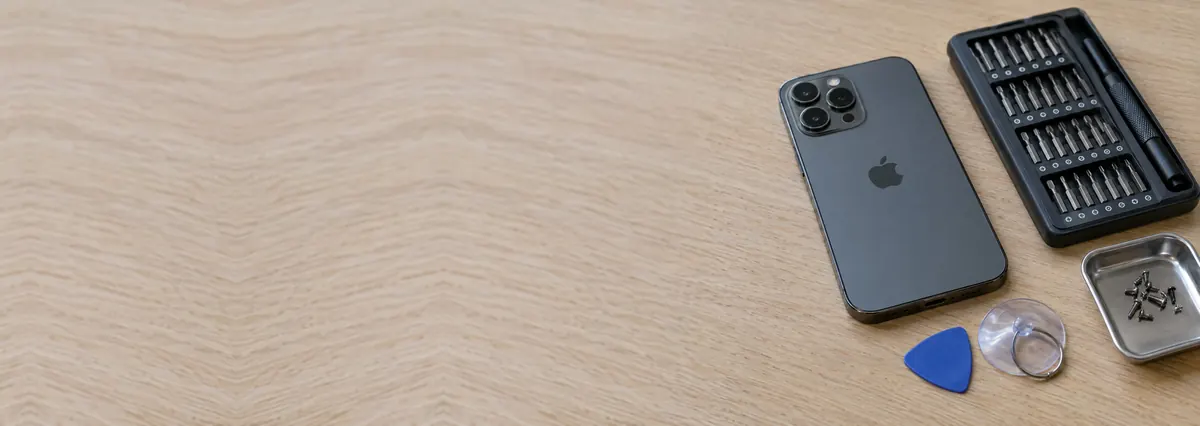
Most iPhone faults are one part or one component. We tell you which, in writing, before you commit to anything.
The failure pattern is narrow and well understood. Glass and display assemblies break on impact. Batteries lose capacity on a predictable curve and eventually trip the performance-management throttle, or swell and push the display out of the chassis. Charging becomes intermittent, which is usually a worn Lightning or USB-C port full of pocket lint, and occasionally the charging IC behind it. Liquid gets in and corrosion begins working on the board immediately.
Beyond that sit the faults most shops will not touch: no power, boot loops that survive a restore, no backlight, no service, a rear camera that will not launch, or a device that heats the moment it is plugged in. These are board faults. They are repairable at component level, and they are the reason a microscope and a hot-air station sit on our bench.
The economics here are worth stating plainly. Apple's out-of-warranty path for a board fault is a whole-unit replacement, because that is the fastest safe process at their scale. It is also the most expensive outcome for you, and on a device with no recent backup it is the one outcome that guarantees your photos are gone. A component-level repair keeps the original board, which means it keeps your data.
That is the case for an independent workshop, and it is also the case against one when it is done badly. A board repaired by someone guessing, with the wrong flux and too much heat, is worse than a board that was replaced. Ask any shop to show you the fault under magnification before they quote. We will.
Diagnostic reference
Reference codes are ours. Quote one when you message us and we can prepare the right parts before you arrive.
An iPhone that survived a spill and worked for a week is not a device that escaped. It is a device where corrosion has been progressing under the shields since the moment the liquid arrived. Salt water and sweetened drinks are worse than clean water; they leave conductive residue that keeps drawing current across traces that were never meant to be connected.
Turn it off. Do not charge it, do not plug it into a computer, do not put it in rice, and do not run it through a hairdryer. Bring it in. The first hour matters more than anything you can do at home, and the correct first step is disassembly, board removal and an ultrasonic clean before power is ever reapplied.
Some iPhone components are cryptographically paired to the logic board at the factory. The Face ID dot projector is the strictest: if it is damaged, Face ID is gone for good on that device, and no replacement part will restore it, which is a security property of the design rather than a fault in the repair.
Batteries and displays are softer cases. A genuine part transferred correctly keeps full function. A third-party part may trigger a service message in Settings, and on some models will disable True Tone or battery health reporting. We will tell you which of those you are choosing between before you choose, rather than after.
How the repair runs
We record what happened and when. A device that was dropped, a device that met liquid and a device that simply stopped are three different investigations.
Visual inspection, power draw on the bench supply, and board inspection under the microscope where the symptom points at the board.
You get the fault, the proposed fix and the price. Nothing is opened further, and nothing is ordered, until you say yes.
ESD-controlled bench, grounded mat, battery isolated before any connector is touched. Board-level work is done under the scope with hot air and a soldering iron, not by swapping.
We reproduce the conditions that caused the fault and confirm it is gone, then run the device under load before it goes back in its box.
Terms printed on the job sheet. Old parts returned on request where they are not exchange units.
Related services
Screens, batteries, ports and cameras — what we replace and what you lose.
See the service →No power, boot loops, no backlight, no service. Component-level diagnosis.
See the service →When the device is gone but the photos are not negotiable.
See the service →Questions we get every week
Verified Google reviews
Every review below is a real, unedited review from our Google profile, shown with the customer’s name as they left it. Read all 940+ on Google.
Excellent service. Fixed my iPhone X screen within a reasonable budget. Will recommend!!!
Great experience at this outlet! Managed to resolve my unresponsive screen for my iphoneXS within the day itself! Very happy with the service rendered :)
Contacted them on WhatsApp, they given a quote and provided a free diagnosis before processing with any repair. Fixed my iPhone 8’s screen within 1-2working day.
Texted them and got a very fast reply for an iPhone battery replacement. Service is swift and professional. Recommended!
Diagnostics first, quote second, repair third — and you decide between each one. Bring it in, or send a photo and we will tell you what we think it is.
Repair costs and common faults vary a lot by generation, so we write a dedicated guide for the models we see most. Each one sets our price bands against Apple’s own published Singapore figures for that exact model. Read iPhone 16 repair for the generation that added the Camera Control, iPhone 15 repair for the first USB-C iPhone, iPhone 14 repair for the generation where back-glass repair splits sharply between the standard and Pro models, or iPhone 13 repair for the swollen battery question that dominates that generation.
Some faults are better looked up by symptom than by model. If the phone has simply gone quiet, start with iPhone sound not working — it covers the three settings that explain most silent iPhones before any repair is on the table.
Related