Short runtime, sudden shutdowns, a bowing base or a trackpad that will not click. We measure cycle count and true capacity, check whether the charging circuit is the real culprit, and fit a pack whose rated capacity we will state in writing.
★★★★★ 4.8 Google rating940+ Google reviewsSame-day repairs on common faultsWarranty on parts and labourDiagnostics before you commit
RefSymptomLikely causeTurnaround
BAT-01Trackpad clicks badly, base bowsSwollen lithium cellSame day — stop using
BAT-03Dies at 30% without warningCollapsed cell, bad calibrationSame day
BAT-05"Plugged in, not charging"Charging IC or battery MCU1–3 days
BAT-08Runtime halved in a yearHigh cycle count, heat exposureSame day
Battery faults from this week's bench log
30 min
Typical same-day fitting time
500+
Cycles before most packs hit 80%
80%
Charge cap we recommend for desk use
4.8
Google rating
Looking for the price? The price guide for this page is further down — jump straight to it ↓. Diagnosis is free on a walk-in, you get the price in writing before any work starts, and if we cannot fix it you do not pay a repair fee.
If your battery is swollen, stop reading and do this
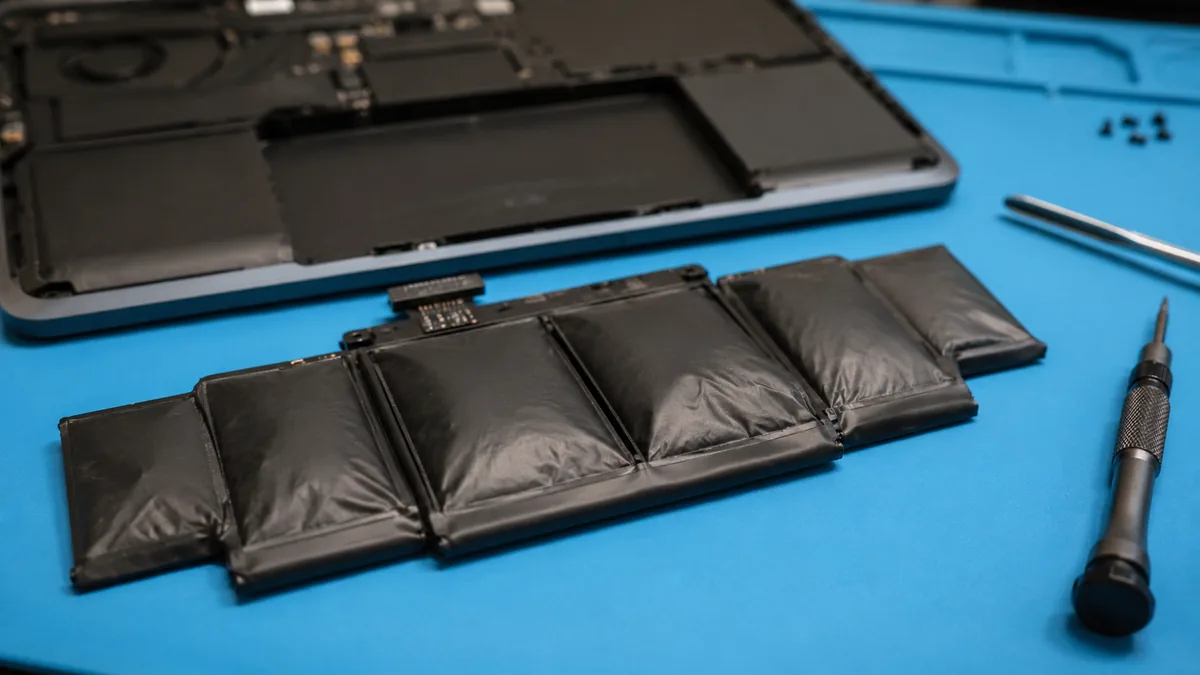
Power the laptop off. Unplug the charger. Do not press the bulge, do not close it in a bag, do not leave
it on a bed, sofa or carpet. Put it on a hard, non-flammable surface, away from paper and fabric, and bring
it in today. A swollen lithium-polymer cell is a pressurised cell with a compromised separator. Puncture it
and you have a fire that water will not extinguish. This is the one repair we ask people not to postpone.
Why lithium packs age, in plain language
A lithium-ion cell stores energy by shuttling lithium ions between a graphite anode and a metal-oxide
cathode. Every cycle deposits a thin, irreversible film on the anode — the solid electrolyte interphase —
which permanently consumes a little lithium and a little capacity. That is normal ageing, and it is why a
pack rated for 500 to 1,000 cycles falls to about 80% of its design capacity by the end of that count.
Two things accelerate it dramatically. Heat: the film grows faster at temperature, which
is why a gaming laptop that lives at 45°C on a desk ages its battery roughly twice as fast as the same
machine kept cool. And high state of charge: a cell held at 100% sits at maximum electrode
stress. Held at 100% and hot, degradation compounds. Swelling arrives when electrolyte decomposition
produces gas faster than the pouch can contain it — a late-stage symptom, and the reason we treat it as
urgent rather than cosmetic. The reference we point customers at is
Battery University's ageing tables, which quantify all of the above without selling
anything.
How to check your battery yourself, in two minutes
You do not need a technician to know whether you need a battery. You need two numbers.
Windows. Open Command Prompt and run powercfg /batteryreport. Open the HTML
file it names. Compare Design Capacity with Full Charge Capacity, and note the cycle count.
Below 70% of design, or above the rated cycle count, means replacement.
macOS. Hold Option, click the Apple menu, choose System Information, then Power. Read
cycle count and condition. Apple's own guidance on
Mac notebook battery
cycle counts lists the rated maximum for every model.
Physical check. Close the lid and set the laptop on a flat table. If it rocks, or the
trackpad no longer clicks, or the base has developed a visible bow, the pack is swelling. That overrides
every number above.
A number worth knowing before you pay
Ask any shop what rated capacity, in watt-hours or mAh, the pack they are fitting carries. A pack sold
as a replacement for a 57Wh original that quietly contains 41Wh of cells is not a bargain; it is a 28%
shorter working day. We print the figure on your job sheet.
Swollen pack? Bring it in today, not next week
Same-day replacement on most models, licensed disposal of the old cell, and a written statement of the capacity of the pack we fit.
Perhaps a quarter of the machines that arrive here for a battery leave with their original pack. "Plugged
in, not charging" is a message from the operating system, not a diagnosis. The charge path runs from the DC
jack or USB-C port, through input protection, into a charging IC, into the pack's own protection board, and
back to a battery management controller that reports state. A fault anywhere on that chain produces identical
symptoms to a dead battery.
Failed charging IC. Common on machines that have taken a knock or a small spill. A
board-level replacement, and far cheaper than the pack. See
motherboard repair.
Worn DC-in jack or USB-C port. Years of angled plugging. Charges intermittently, or
only if you hold the cable.
Failed protection board on the pack. The cells are fine; the small PCB that guards them
is not. Sometimes replaceable, often not worth it.
Corroded battery connector. Frequently the aftermath of a spill months earlier. Cleaned
under the microscope and re-tinned.
Third-party charger with the wrong PD profile. The laptop negotiates a lower voltage,
charges glacially, and blames the battery.
Our intake test takes ten minutes: read the pack's own telemetry over its SMBus, measure the charge rail
under load, and swap in a known-good bench charger. Only after those three do we quote a battery.
Original, equivalent, and the packs we refuse to fit
Where an original manufacturer pack is available at a defensible price, we fit it. Where it is discontinued
— which happens fast on machines over four years old — we fit an equivalent built on genuine cells from
a named manufacturer with a proper protection board, and we tell you the cell brand and the rated capacity
before you agree. What we will not fit, at any margin, is an unbranded pack with an unmarked protection board
and a capacity claim nobody can verify. Those packs are the ones that swell in fourteen months, and they are
why so many customers assume all replacement batteries are bad.
Laptop Battery Replacement Singapore
Battery replacement price guide
Indicative laptop battery replacement prices in Singapore
Machine type
Pack
Indicative fitted price
Turnaround
Mainstream 14–15.6" laptop
Serviceable, screwed
S$90 – 160
Same day, 30–60 min
Business ultrabook
Internal, screwed
S$120 – 190
Same day
Thin ultrabook / convertible
Adhered pack
S$140 – 230
Same day, 2–4 hrs
Gaming laptop (80–99Wh)
Large multi-cell
S$170 – 270
Same day
MacBook Air / Pro
Adhered to top case
S$150 – 320
Same day – 2 days
Charging IC repair
Board-level, pack retained
S$140 – 280
1 – 3 days
DC-in jack / USB-C port
Board-level
S$110 – 260
1 – 2 days
Battery health assessment
Report, no parts
Free with any repair
10 minutes
Indicative bands, not offers. Every quote is confirmed in
writing after diagnostics and does not change afterwards.
Laptop Battery Replacement Singapore
Our replacement process
Telemetry and charge-path test
We read cycle count, design capacity and full
charge capacity from the pack itself, then verify the charging rail before blaming the battery.
Physical safety inspection
Bow, pouch pressure, connector corrosion and heat
marks. Swollen packs are isolated immediately and handled with insulated tools.
Written quote with the capacity stated
Pack type, cell brand, rated watt-hours,
fitted price, warranty term. All before we open the machine.
ESD-controlled removal
Grounded bench, wrist strap, battery isolated first.
Adhered packs released with controlled heat and approved solvent, never levered.
Fit, seat and cycle test
New pack installed, connector torqued correctly, then a
full charge and controlled discharge to confirm reported capacity matches the label.
Charge limiter set up & safe disposal
We enable your manufacturer's charge
cap and show you where it lives. The old pack leaves in a fire-rated container for licensed e-waste
recycling.
Making the next pack last twice as long
Cap the charge at 60–80% whenever the machine lives on a desk, using Lenovo Vantage, Dell Power Manager,
MyASUS, HP Battery Health Manager, or macOS Optimised Charging. Keep the laptop off duvets and cushions, which
block the intake and hold the pack at 45°C for hours. Avoid habitual discharge to zero; shallow cycles
between roughly 30% and 80% are gentler than deep ones. If you are storing a laptop for months, leave it near
50% charge, not full and not empty. And service the cooling — a clean fin stack keeps the pack cool as a
side effect, which is one more reason a
thermal service is the best value repair on our price list.
Why customers choose iDevice for battery replacement
Because we check whether the battery is the fault before we sell you one. Because we state the rated
capacity of the pack in writing, and name the cells. Because swollen packs are treated as the safety issue
they are, handled with the right equipment and disposed of through a licensed channel. And because our bench
is ten minutes from the CBD and reachable from Orchard, Novena, Toa Payoh, Bishan, Ang Mo Kio, Jurong East,
Clementi, Queenstown, Tampines, Bedok, Woodlands, Yishun, Hougang and Punggol — where 940+ customers have
averaged us 4.8 stars.
Verified Google reviews
4.8 stars across 940+ reviews
Every review below is a real, unedited review from our Google profile, shown with the customer’s name as they left it. Read all 940+ on Google.
★★★★★
Nash was super efficient while staying laid back. Didn't need to sign any form when depositing the laptop for a battery replacement. Got the device back after a couple hours as they promised. Receipt was sent promptly via WhatsApp. Will come back the next time I have an issue with my MacBook!
★★★★★
Steven was very helpful, and provided fast service. Had come here for my Macbook battery replacement. Will come again.
★★★★★
Recently I got my MacBook Air battery replaced, charges are very competitive and quick service. Highly recommended.
★★★★★
got to the shop after 5pm to replace my macbook pro battery, friendly stuff who did the job before shop closes 6pm. great service
Questions we get every week
Laptop battery questions, answered properly
How much is a laptop battery replacement in Singapore?
Most mainstream laptops land between S$90 and S$160 fitted, including removal, testing and safe disposal of the old cell. Ultrabooks with bonded batteries, gaming laptops with large multi-cell packs, and MacBooks where the pack is adhered to the top case run S$140–320. The price is driven by the pack, not the brand: a 99Wh six-cell pack costs more than a 42Wh three-cell one, and always will. Send the model and we will confirm.
My laptop battery is swollen. Is it dangerous?
Yes, and this is the one question on this site where we will not be relaxed. A swollen lithium-polymer cell is a cell whose electrolyte has decomposed into gas. It is under pressure, its separator may be compromised, and puncturing or crushing it can cause a thermal runaway fire that cannot be put out with water. Stop using the laptop. Do not charge it. Do not press the bulge flat, do not put it in a bag, and do not leave it on a bed or sofa. Power it off, put it on a hard non-flammable surface away from anything that burns, and bring it to us the same day. We handle swollen packs daily and dispose of them through a licensed e-waste channel.
How do I know when a battery actually needs replacing?
Two numbers, both available for free. Cycle count — one cycle is one full discharge worth of energy, not one plug-in. Most modern packs are rated to 500–1,000 cycles before they fall to 80% of design capacity. Full charge capacity versus design capacity — if the pack was designed for 57,000mWh and now reports 31,000, you have 54% of the battery you paid for. On Windows, run powercfg /batteryreport from Command Prompt and open the HTML file it writes. On macOS, hold Option and click the Apple menu, then System Information → Power. If capacity is below roughly 70%, or the machine shuts down unexpectedly above 20%, replace it.
Should I leave my laptop plugged in all the time?
Plugged in is fine; plugged in at 100% and warm is not. Lithium cells age fastest at high state of charge and high temperature, which is exactly the condition of a docked gaming laptop sitting at full charge. The fix is a charge limiter, and most manufacturers ship one: Lenovo Vantage Conservation Mode, Dell Power Manager, ASUS MyASUS Battery Health Charging, HP Battery Health Manager, and Optimised Battery Charging on macOS. Cap the charge at 60–80% for desk use and the pack will outlive the laptop.
Is a third-party battery safe, or must I buy the original?
Both statements in that question are half-truths. The safety of a pack lies in its cells and its protection circuit — the small board that manages charge balancing, over-current cutoff and temperature. A reputable third-party pack with genuine cells and a proper protection board is safe. A no-name pack sold at half the going rate has neither, and we have opened enough of them to say so. We fit original packs where they remain available and high-grade equivalents where they do not, and we tell you which one you are getting and what its real rated capacity is.
Can you recover the battery instead of replacing it? I have seen "recalibration" offered.
Calibration fixes a reporting problem, not a chemistry problem. If your battery reports 60% and then dies, a full discharge-and-recharge cycle can resynchronise the fuel gauge and the machine behaves again. That is worth doing, and it costs you nothing but time. What calibration cannot do is restore lost capacity, reverse cell swelling, or repair a failed protection board. Anyone selling "battery reconditioning" for a swollen pack is selling you a fire risk.
How long does the replacement take?
Most laptops: 30 to 60 minutes, same day, while you wait or over lunch. Machines with adhered packs — MacBooks, Surface, thin ultrabooks — take two to four hours because the adhesive strips must be released slowly with controlled heat and solvent rather than levered out. Where the charging circuit is also faulty, add one to three days for board-level work.
What happens to my old battery?
It goes into a fire-rated container and then into Singapore's licensed e-waste stream under the Extended Producer Responsibility scheme. Lithium packs must never enter household refuse or a recycling bin — compaction in a refuse truck is one of the more common causes of waste-facility fires. We take the old pack off your hands at no charge, and if you would rather dispose of it yourself, use a designated e-waste bin, not the chute.
Get a battery quote with the capacity written down
Send us your model and the two numbers from your battery report. We will tell you whether you need a pack, a charging IC, or simply a charge limiter.