A dead laptop is rarely a dead board. We diagnose the mainboard on a bench supply and a
thermal camera, trace the fault to the actual failed component, and repair it under the microscope — instead
of quoting you the price of a whole replacement board.
★★★★★ 4.8 Google rating940+ Google reviewsDiagnostics before you commitWarranty on parts and labourNo fix, no repair fee
RefSymptomLikely causeTurnaround
MB-01Dead, no LED, no fanShorted rail or charging IC2–5 days
MB-04Fans spin, screen black, no POSTRAM, BIOS, CPU/GPU solder1–5 days
MB-07Died days after a spillProgressive trace corrosion3–7 days
MB-11Artefacts, then no displayGPU solder fatigue3–7 days
A slice of this week's board bench log
1 in 5
No-power cases truly need a board
8–12
Layers in a modern mainboard
20–40×
Microscope magnification
4.8
Google rating
The short version
Board-level laptop repair starts at around S$180 and is quoted by bench hours, typically 3–7 days, case by case. Diagnosis is free on walk-ins, you get a written quote before any work starts, and if we cannot fix it you do not pay a repair fee. See how we arrive at that.
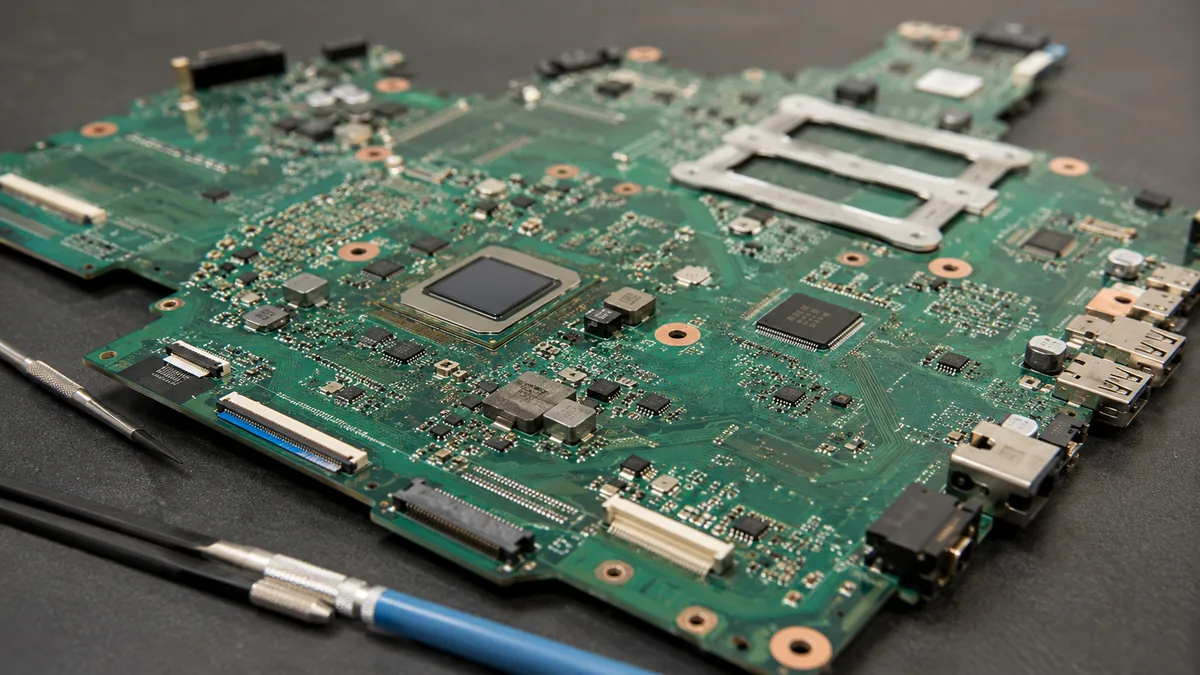
The laptop motherboard — the mainboard or logic board — is the single circuit board that everything else
plugs into. It carries the CPU, the memory, the power-delivery circuitry that turns your charger's voltage into
the dozen or so rails the machine needs, the charging controller, an embedded controller that supervises boot,
the input-output ports, and on many machines a discrete graphics chip with its own power delivery. When people
say a laptop is "dead", the fault is almost always somewhere on this board, and almost always in one identifiable
place rather than everywhere at once.
There are two ways a shop can respond to a board fault. The common one across Singapore is board swapping:
decide the mainboard looks faulty, order a replacement, charge you for it. It is quick and highly profitable, and
it is why owners are routinely told a S$1,000 board is dead when the real culprit is a S$4 capacitor. The other
way — the one we practise — is component-level repair: find the single failed component and replace just that. It
needs a schematic, a boardview, a microscope, and someone who can remove and refit parts without cooking the
board around them. It is slower and it is harder, and it saves you most of the money.
The symptoms that point to a motherboard fault
Motherboard problems announce themselves in a handful of recognisable ways. None of them is a diagnosis on
its own, but each narrows the search dramatically before the machine is ever opened:
No power at all. No lights, no fan movement, nothing when you press the button. This is
the classic board-fault presentation — though, as our logs show, only about one case in five is a genuinely
dead board rather than a charging or power-path fault.
Power, but no display and no POST. Fans spin and lights come on, but the screen stays
black and the machine never begins to boot. This points at memory, a corrupt BIOS, or solder fatigue under the
CPU or GPU.
Boot loops and random shutdowns. The machine starts, then cuts out, sometimes under load
and sometimes at idle. Degraded power-delivery components and failing capacitors are typical here.
Will not charge, or charges intermittently. The battery reads "plugged in, not charging",
or only charges at certain cable angles. This is the charging IC, the DC-in jack, or the charge circuit.
Dead ports, distorted video, or no keyboard/trackpad. A single subsystem stops working
while the rest is fine — a torn pad, a blown protection diode, or a failed controller.
Graphical artefacts before a black screen. Coloured blocks, flickering or corruption that
worsens over weeks, then no image — the signature of a GPU losing solder-ball contact.
If your machine matches one of these, send us a two-line description and a photo before you travel; we can
usually give you a probable cause and an honest price band from the symptom alone.
Laptop Motherboard Repair Singapore
Common laptop motherboard faults, and what causes them
Below is the bench reference our technicians use during intake. The reference codes are ours, not an industry
standard — quoting one over WhatsApp simply lets us free the right bench and prepare the right tools before you
arrive. Turnaround assumes the fault behaves the way the symptom suggests; a board fault we have not yet traced
never gets a fixed schedule.
Diagnostic reference
Motherboard fault reference
The faults that account for most board repairs on our bench, in roughly the order we see them.
RefSymptomMost likely causeTypical turnaround
MB-01Dead, no LED, no fanShorted rail, failed charging IC, blown input fuse2–5 days
MB-02High current draw, no power-onCeramic capacitor shorted to ground on a rail1–4 days
MB-04Fans spin, screen black, no POSTRAM fault, BIOS corruption, CPU/GPU solder1–5 days
MB-05Plugged in, not chargingCharging IC, DC-in jack, battery gauge1–3 days
MB-07Worked, then died days after a spillProgressive electrochemical trace corrosion3–7 days
MB-09Random restarts under loadDegraded VRM capacitors, weak power stage2–5 days
MB-11Artefacts, then no displayGPU solder-ball fatigue, needs reball3–7 days
MB-13USB / port dead or intermittentTorn pad, blown protection diode, worn socket1–2 days
Tell us the symptom. We will tell you the likely cause.
Send a photo and a two-line description of what the machine does. A technician replies with a probable diagnosis and an honest price band before you leave the house.
Our laptop motherboard repair process, step by step
Every board that reaches our bench follows the same disciplined path. The point of a fixed process is that
nothing is skipped and nothing is guessed — a board rewards patience and punishes shortcuts.
Symptom capture and history. What the machine does, when it started, and what happened
just before — a spill, a drop, a bad charger, a failed update. The history often narrows a board fault faster
than any instrument.
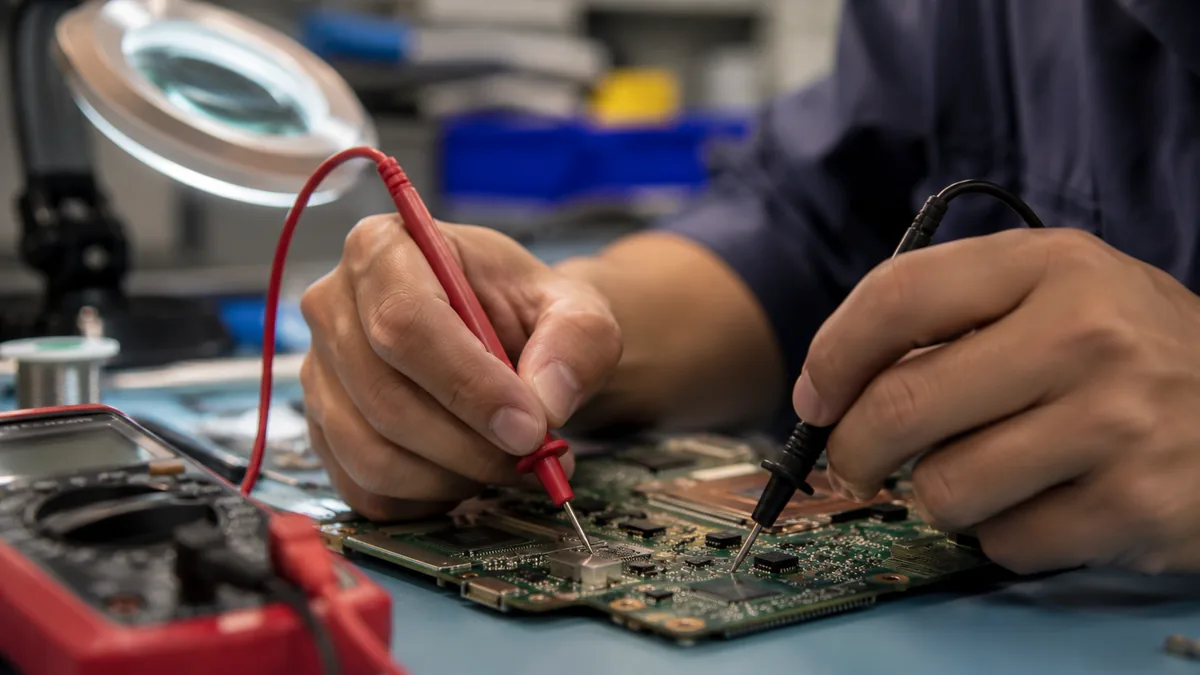
Bench power-supply current reading. The board goes onto a bench supply set to its rated
input voltage with the current limit clamped low. What it draws in the first second tells us most of the
story: zero draw means an open power path, high draw means a shorted rail, and normal standby with no boot
means a rail is not sequencing.
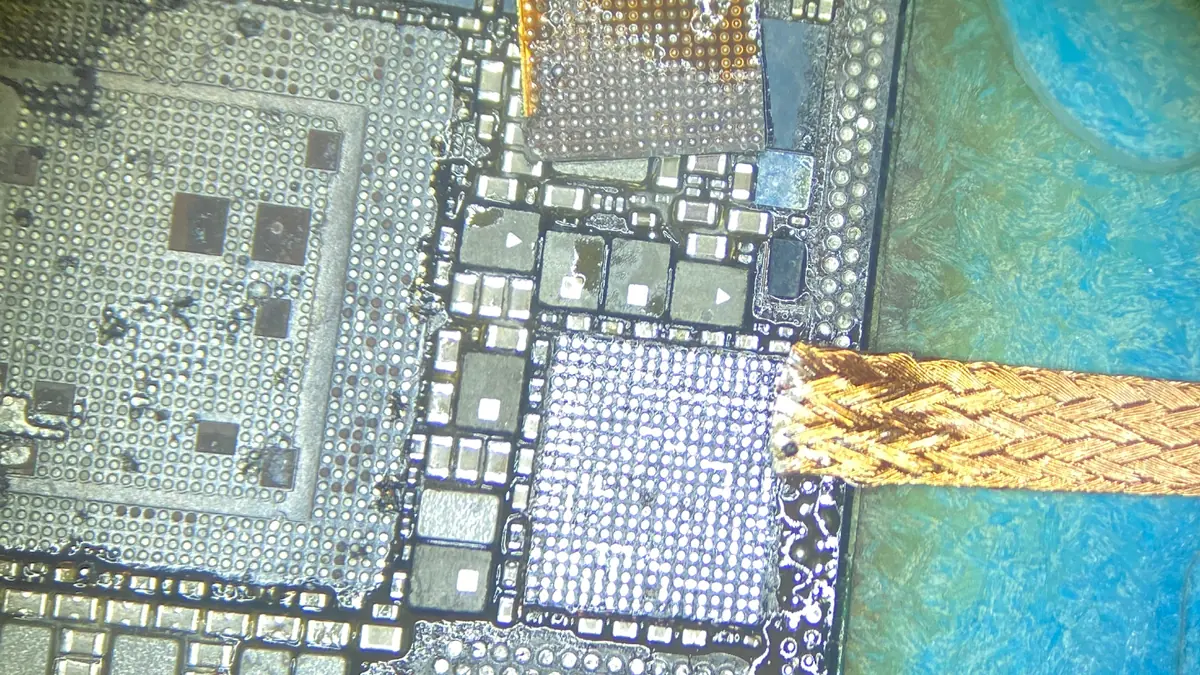
Thermal and visual inspection. On a shorted board we freeze-spray or use a thermal
camera to find the component heating up — nine times in ten a single ceramic capacitor. Under a stereo
microscope at 20–40× we look for corrosion, lifted pads, cracked joints and cold-cracked parts invisible at
arm's length, and we photograph what we find.
Schematic and boardview tracing. Where the fault is not a simple short, we go to the
schematic and boardview and probe the enable and power-good lines in order until the failing stage reveals
itself.
Rework. Our board bench runs a preheater at 150–180°C, a hot-air station with controlled
airflow, a microscope and low-temperature bismuth solder for delicate work. Shorted components are removed and
replaced, broken traces are jumpered with enamelled wire, corroded pads are cleaned back to copper and
re-tinned, and BGA chips are reballed where contact is genuinely lost.
Bench-test, then soak-test. The repaired board is powered on the bench supply and
verified before it goes back into the chassis, then the assembled machine is load- and soak-tested —
a minimum of 24 hours for liquid-damage boards — before it is handed back with a written warranty on the job
sheet.
Two honest limits sit at the front of every quote. First, a board with catastrophic physical damage — a
snapped PCB, a crater where a connector used to be, a delaminated CPU package — is often beyond economical
repair, and we say so on day one rather than after you have paid. Second, some designs pair the storage or a
security element to the board cryptographically, so replacing the board means the storage cannot be read
afterwards; that is a data recovery decision as much as a
repair decision, and we raise it before we touch anything.
Laptop Motherboard Repair Singapore
Reflow versus reball: why the distinction matters
When a laptop develops graphical artefacts and then loses its display, the cause is often a graphics chip
whose solder balls have fatigued and lost contact after years of heating and cooling. There are two responses,
and only one of them is a real repair. A reflow simply heats the board until the old solder
softens and, with luck, re-seats the cracked joint. It can bring a machine back for a few weeks, which is why
unscrupulous shops sell it — but the underlying solder is still fatigued, and it will fail again, usually worse,
and the heat makes the eventual proper repair harder. A reball removes the chip completely,
cleans away all the old solder, applies a fresh, uniform set of solder balls with new underfill for mechanical
support, and refits it. That is the permanent fix, and it is the only board-level graphics repair we will put
our name to. We also tell you honestly when a reball is not worth doing against the machine's value — a truthful
"replace it" is part of the service.
Laptop Motherboard Repair Singapore
Preventive tips: how to keep the board healthy
Most of the boards we repair failed for reasons that were, in hindsight, avoidable. A few habits meaningfully
extend a mainboard's life in Singapore's heat and humidity:
Keep liquids away from the keyboard. The single most destructive thing that happens to a
board is a spill, and the damage is progressive — see our
liquid damage guidance. If it does happen, power off immediately and bring it in the same day; do not wait
for it to "dry out".
Service the cooling before it bakes the board. Heat is what ages solder joints and
capacitors. A machine that runs hot and loud is cooking its own board — a
fan service and repaste is cheap insurance against an expensive board fault later.
Use a proper charger. Cheap unbranded adapters deliver dirty power and stress the charging
circuit and DC-in jack. Use the correct wattage and a reputable charger, and plug in gently rather than at an
angle.
Protect against surges. A decent surge-protected outlet costs little and shields the
power-delivery front end from spikes that can take out the charging IC.
Do not ignore small faults. A port that has become intermittent or a fan that has started
ticking is the board telling you something. Small faults handled early rarely become board-level ones.
Back up regularly. A healthy backup habit turns a worst-case board failure from a
catastrophe into an inconvenience, especially on machines with soldered storage.
Why customers trust us with a board repair
Because we show you the fault under the microscope and photograph it. Because the quote is written before any
rework starts and does not change afterwards. Because every completed repair carries a written warranty on parts
and workmanship, and if we cannot fix it you do not pay a repair fee. And because a board is the one repair where
honesty is worth more than the margin on an unnecessary part — telling you the truth about your machine, including
when the truth is that it is not worth saving, is the whole basis of the trade we have built over fourteen years.
Verified Google reviews
Board repairs, in customers' words
Every review below is a real, unedited review from our Google profile, shown with the customer’s name as they left it. Read all 940+ on Google.
★★★★★
Great experience. we were still worried about device not been able to retrieve the data. Repaired motherboard and data retained within a few days. Nash was patience and explained the procedure to us and highlighted to us the things to look out for.
★★★★★
Was able to fix water damage/ motherboard issue in around 1 week, service was good as well.
★★★★★
Nash and Melissa were super accommodating and helped me on an urgent repair of a motherboard failed MacBook Pro! Saved me so much time! Appreciate the helps!
★★★★★
I have brought my Macbook Pro to them to fix my water damage. They are very responsive and the price is much more affordable than apple. I am glad to have my motherboard fixed. Thanks for the service. It took around 1 week, which is quite fast. Thanks for the service
How much does laptop motherboard repair cost in Singapore?
Component-level board repair is priced by bench time and difficulty, not by the size of the part, because the part is often a capacitor or a charging chip that costs a few dollars. A found-fast fault such as a shorted capacitor or a failed charging IC typically sits in the low-to-mid hundreds; a traced intermittent fault, a GPU reball with fresh underfill, or liquid-corrosion recovery runs higher because it takes longer on the bench. We read the board on a bench supply first, then give you a written quote you approve before any rework begins.
Is it cheaper to repair the motherboard or replace it?
Almost always cheaper to repair the fault than to replace the whole board. A replacement mainboard is one of the most expensive parts in the laptop and often has to be sourced, whereas the real fault is usually a single failed component on an otherwise healthy board. That is the entire argument for component-level work: we fix the twenty-cent cause instead of selling you the thousand-dollar assembly around it. Where the board is genuinely beyond economical repair, we tell you on day one.
My laptop has no power at all. Does that mean the motherboard is dead?
Usually not. In our intake logs a genuinely dead board is roughly one in five no-power cases. The rest are charging ICs, blown input fuses, failed DC-in jacks, faulty power buttons, dead batteries preventing boot, or a single shorted component pulling a rail to ground. We put the machine on a bench power supply and read the current it draws in the first second — zero draw points to an open circuit, high draw points to a short, and normal standby with no boot points to a sequencing fault. That one number decides the repair.
What is the difference between a reflow and a reball, and which do you do?
A reflow simply heats the board until the existing solder softens and hopefully re-seats a cracked joint; it can revive a machine for a few weeks and is not a real repair. A reball removes the chip entirely, cleans off the old solder, applies fresh solder balls and new underfill, and refits it — that is the permanent fix. We do not sell reflow as a lasting repair. Where a GPU or PCH has genuinely lost solder-ball contact we reball it, and we tell you honestly when a reball is worth doing against the value of the machine.
Will I lose my data during a motherboard repair?
The storage is separate from the fault in most laptops, so your data is normally safe throughout a board repair. Where the storage is soldered to the board — as on some ultrabooks and 2-in-1s — we treat the job as a data question as well as a repair, and we raise that before touching anything. Even when a board is beyond repair we can usually pull or read the storage and recover your files; our data recovery service images drives on write-blocked hardware so nothing is written to a failing disk.
How long does laptop motherboard repair take?
Three to seven working days is realistic for most board repairs. Tracing an intermittent fault on a multilayer board is not a fixed-duration task — the honest answer is that we do not know on day one whether it is a shorted capacitor found in an hour or a deeper fault found on day four. Liquid-damage boards need soak-testing time after cleaning. We update you at the point we actually know what the fault is, not only at the end, and we never rush a board because rushing a board is how boards die.
Do you repair water-damaged and liquid-damaged laptop boards?
Yes, and the sooner it reaches us the better the odds. Liquid does not kill a board by shorting it once; it kills it slowly through electrochemical corrosion that keeps eating traces for days. We fully disassemble, disconnect the battery, clean the boards ultrasonically, clear corrosion back to copper, re-tin pads, jumper broken traces under the microscope, and replace shorted components — then power the board on a bench supply and soak-test it before it goes back into the chassis. Brought in the same day, recovery odds are strong; after a week of intermittent use they fall sharply.
Bring the board in, or send us a photo first
Walk-ins welcome from the CBD, Orchard, Novena, Toa Payoh, Bishan, Ang Mo Kio, Jurong East, Clementi, Tampines, Bedok, Woodlands, Yishun, Hougang and Punggol. Courier collection islandwide for machines that should not be moved.