
iPhone guides · Singapore
iPhone water damage: what to do in the first ten minutes
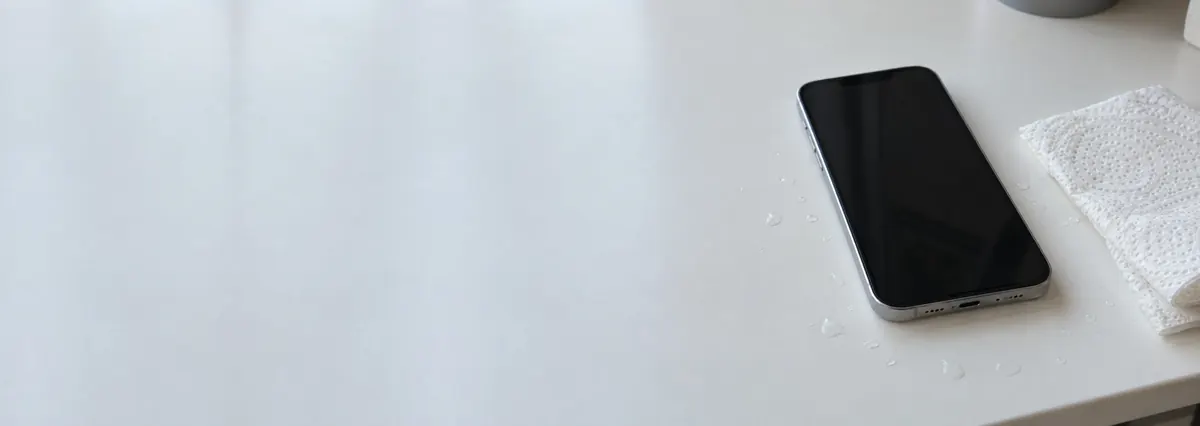
A wet iPhone is not a moment of damage — it is the start of a slow one. The water that goes in is rarely what kills the phone; the corrosion it leaves behind is. What you do in the first ten minutes, and what you deliberately don't do, decides whether the phone lives.
On this page
- The first ten minutes: what to do right now
- The three things that quietly kill wet phones
- Why the rice trick fails every time
- Corrosion: the real damage happens later
- Not all water is equal: pool, sea, coffee, toilet
- What professional board cleaning actually involves
- Water resistance, IP ratings and warranty
- iPhone water damage repair costs in Singapore
The first ten minutes: what to do right now
If your phone has just come out of the water, the clock is already running. The most useful thing you can do is deny the board the two things that turn a wet phone into a dead one: power and time.
- Get it out and switch it off. Do not check whether it still works — just power it down. Electricity plus water is what corrodes and short-circuits a live board.
- Dab it dry, gently. Pour off standing water and blot it with a soft cloth; shaking only pushes liquid deeper in.
- Do not plug it in. Charging a wet phone sends current straight across a wet board — this is how a survivable dunk becomes a fried charging circuit.
- Do not open the phone yourself. Prising the screen off at home lets in dust and damages the fragile flex cables.
- Get it to a workshop the same day if you can. Everything after the first hour is about limiting how long corrosion has to work.
That is the whole home checklist. No household trick beats getting a switched-off phone onto a bench quickly — our iPhone water damage repair service starts with a free diagnosis so you know where you stand.

The three things that quietly kill wet phones
Most water-damaged iPhones we see were not killed by the water. They were killed in the hours afterwards by well-meaning owners doing one of three things — avoid all three.
1. Turning it back on to "check if it works." This is the big one. Every second it runs while damp, current flows through paths never meant to carry it — and that is what burns out a charging IC or backlight circuit. A phone that would have cleaned up perfectly, lost in the time it takes to see the Apple logo.
2. Charging it. A wet charging port and a live charger is the worst possible combination — you are pushing mains-derived current across a board bridged with conductive water. A dead charging circuit after a spill is almost always this.
3. Using heat to "dry" it. Hairdryers, ovens, sunny windowsills and radiators do more harm than good — heat warps the display, cooks the battery and drives moisture deeper under the shields. Gentle room-temperature air is fine; anything hotter is a gamble with the most expensive parts of the phone.
The uncomfortable truth: a wet iPhone that still switches on has not survived — it is on borrowed time. The corrosion has started; it just hasn't reached anything critical yet, and that window is when a clean is easiest and cheapest.
Why the rice trick fails every time
The bowl of rice is the most persistent myth in phone repair, and the belief itself is dangerous: rice feels like action, so people do it and wait — and the waiting is the damage.
Rice cannot reach the sealed inner layers of the board, where the water sits under metal shields and behind connectors. It does nothing about the minerals and salts already left on the circuitry — those keep corroding whether the surface feels dry or not. And it is slow: the two or three days a phone sits buried in rice are precisely the window in which corrosion spreads across a board under residual battery voltage. Silica gel suffers the same fatal flaw — it cannot touch water already inside a sealed assembly. The only reliable fix is to open the phone and clean the board directly.

Corrosion: why the real damage happens days later
Forget the splash and think about the week that follows. Pure water is fairly harmless, but no real-world water is pure — tap water, seawater, coffee and juice carry dissolved minerals, salts and sugars, and once the water evaporates those conductive deposits stay welded to the board.
They do two nasty things: they bridge tiny gaps between components meant to be separate, causing shorts; and with even a trace of battery voltage they drive electrolytic corrosion — the same process that rots a car battery terminal, across circuitry finer than a hair. This is why an iPhone can seem fine for a week or two, then start doing odd things: no charging, no signal, a dimming screen, random reboots, or one day simply not switching on.
This delayed timeline changes the right decision. A phone opened and cleaned on the day of the spill is often a quick job; the same phone left in a drawer for a fortnight can need parts-level work on the logic board. Same accident, very different repair — decided by how fast it reached us.
Wet phone right now? Switch it off and message us.
Send the model and one line on what it fell into — the sooner corrosion is stopped, the cheaper and more likely the fix. Free diagnosis, and a written quote before anything is touched.
Not all water is equal: pool, sea, coffee and toilet
What your phone fell into changes how urgent the job is, because different liquids leave different levels of corrosive residue. Roughly in order of how aggressive they are:
- Seawater is the worst — salt is extremely conductive and corrodes fast, so a phone dropped at the beach needs same-day treatment above all.
- Pool and chlorinated water carries chemicals that attack solder and coatings — less brutal than seawater, still urgent.
- Coffee, tea, juice and soft drinks add sugar, leaving a sticky film that gums up buttons and ports — worse than plain water despite feeling more innocent.
- Tap and toilet water are the "best" case, but tap water still carries minerals and toilet water carries bacteria.
Whatever the liquid, the response is the same: power off, do not charge, come in fast.

What professional board cleaning actually involves
When a liquid-damaged iPhone reaches a proper bench, "drying it out" is not the job — removing the corrosion is. The process is methodical:
- Full disassembly and battery disconnect so no more current can drive corrosion, and the board comes fully out of the chassis.
- Inspection under a microscope to map where the liquid travelled and which components show corrosion or burnt tracks. This is what a free diagnosis checks.
- Ultrasonic cleaning. The bare board is bathed in an ultrasonic tank, where high-frequency waves lift residue out of the tiny gaps under chips and shields that no cloth or rice could reach.
- Component-level repair. Anything the corrosion destroyed — a charging IC, a connector, a broken track — is repaired under the microscope rather than by swapping the whole board, which keeps your data on the phone.
- Reassembly and testing. Once clean and stable the phone is rebuilt and tested — and if you had no backup, this is the moment to make one.
Liquid damage is the one repair where we cannot promise an outcome before we look — which is why the diagnosis is free and, if we cannot bring the phone back, you do not pay a repair fee. If your worry is the photos, this same clean-and-revive approach is what makes recovery possible; our guide to recovering data from an iPhone explains why a working board is the only path to the data.
Water resistance, IP ratings and why warranty rarely helps
Modern iPhones carry an IP water-resistance rating that lulls people into a false sense of security. That rating comes from a controlled factory test in still, fresh water — not a pool, the sea, a hot shower, or a drop into a longkang. Water resistance is not waterproofing, and it fades: the adhesive seals age with every drop and battery bulge, so a two-year-old phone is nowhere near as sealed as on day one.
That rating is also not a warranty. Every iPhone has liquid contact indicators — small tabs inside the SIM slot that turn from white to red or pink on contact with water — and if they have tripped a liquid-damage claim is almost always declined. The phone is "water resistant," yet the water damage is specifically excluded. For most owners here, independent component-level repair is the realistic route back, which is why we lead with a written quote — and if the phone is beyond economical repair, we say so plainly, alongside the honest cost of an iPhone repair against a replacement.
iPhone water damage repair costs in Singapore
We never quote water damage sight unseen, because the same splash can mean a quick clean or a multi-day board rebuild. As a rough guide to the bands you might see:
- Same-day ultrasonic clean of a lightly affected board — often the low hundreds.
- Clean plus component work — a charging IC, a connector, or a battery that took a hit — from a few hundred dollars, quoted after diagnosis.
- Heavy corrosion or board-level recovery where the phone will not power on — the most complex case, priced once we have opened it.
The promises are the same across all of them: walk-in iPhone water damage repair diagnosis is free, you get a written quote before any work, we repair at component level to keep your data on the phone, and every completed job carries a written warranty. If the phone genuinely cannot be saved there is no repair fee. And if the water only killed the battery or screen and the board is clean, we point you to the cheaper fix — an iPhone battery replacement or a straightforward iPhone screen replacement — rather than upselling a board job you do not need.
Questions we get every week
Frequently asked questions
My iPhone fell in water but still works — is it fine?
Not necessarily. A phone that survives the first day can still fail a week or two later, because corrosion keeps eating the board long after the screen looks normal. Water leaves behind minerals and salts that slowly bridge circuits and rot solder joints. The safest move is to have the board opened and cleaned while it is still working, rather than waiting for the delayed fault that liquid so often causes.
Does putting an iPhone in rice actually work?
No. Rice is one of the most damaging myths in phone repair. It cannot reach sealed areas of the board, it does nothing about the corrosive minerals already left behind, and the days you spend waiting are exactly when corrosion does its worst. Grains and starch dust can also lodge in the ports. Skip the rice entirely — power the phone off and bring it in quickly instead.
Is my iPhone water damage covered by warranty?
Almost never. Every iPhone has liquid contact indicators that turn red or pink when wet, and a manufacturer will point to those to decline a warranty claim. An IP water-resistance rating is not a warranty either — it is a factory test that fades as seals age, and it does not cover hot showers, pools or seawater. Independent board-level repair is usually the realistic route, and we quote it in writing first.
How much does iPhone water damage repair cost in Singapore?
It depends on how far the corrosion spread and which components were hit. A same-day clean of a lightly affected board sits in the low hundreds; a case needing charging IC, battery or connector work costs more and is quoted only after diagnosis. Walk-in diagnosis is free, you get a written quote before any work, and if we cannot bring the phone back you do not pay a repair fee.
Can you recover photos from a water-damaged iPhone?
Usually, yes, if you act quickly. On an iPhone the data is locked to the board, so the goal is to clean and revive that board long enough to make one backup. The sooner it arrives, the better the odds, because every hour under power lets corrosion spread. If you have no backup, do not keep trying to switch the phone on — each failed boot on a wet board risks the very data you want to save.
Keep reading
Related guides
iPhone water damage repair in Singapore
Ultrasonic board cleaning, component-level repair and a free diagnosis before any quote.
How to recover data from an iPhone
Why a working board is the only path to your photos, and what is possible with no backup.
iPhone repair in Singapore: screens, batteries, ports and boards
Every common iPhone fault, and the one question to ask before any quote.
Get a written quote before a screw turns
Component-level diagnostics, a fixed price in writing, and no repair fee if we cannot bring your phone back. Walk in Mon–Fri, or WhatsApp the workshop.