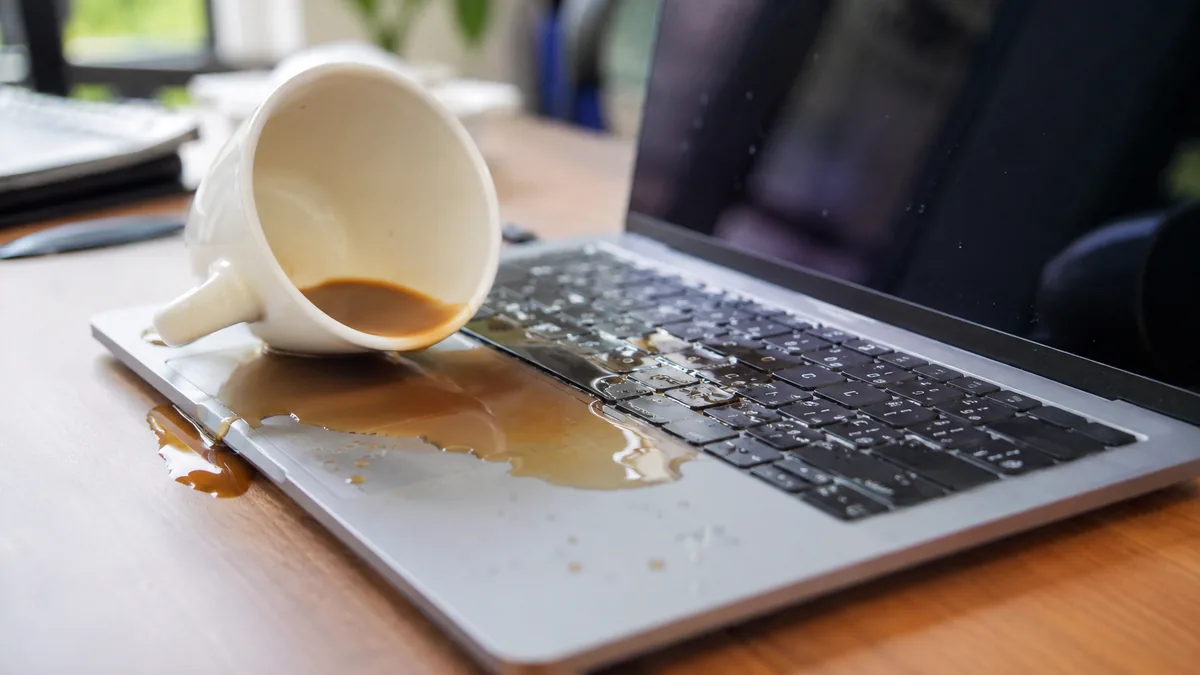
A spill does not kill a laptop with one clean short — it starts a slow corrosion that keeps eating
the board for days. The sooner we clean it, the more we save. We strip the machine down, clean every board
under the microscope, clear the corrosion and soak-test it before it goes home.
★★★★★ 4.8 Google rating940+ Google reviewsSame-day intake, best oddsFree diagnosis, written quoteNo fix, no repair fee
RefSymptomLikely causeTurnaround
LIQ-01Dead the moment it was spilled onShorted rail from bridged pins3–7 days
LIQ-02Worked, died days laterProgressive trace corrosion3–7 days
LIQ-04Sticky, stuck or dead keysResidue under the keyboard1–3 days
LIQ-06Turns on, then random shutdownsIntermittent corroded contacts3–7 days
A slice of this week's liquid bench log
24h+
Minimum soak-test after cleaning
Same day
When recovery odds are strongest
20–40×
Microscope magnification
4.8
Google rating
Looking for the price? The price guide for this page is further down — jump straight to it ↓. Diagnosis is free on a walk-in, you get the price in writing before any work starts, and if we cannot fix it you do not pay a repair fee.
Almost everyone assumes a spill either kills a laptop instantly or leaves it fine. The truth is more dangerous
than either. Liquid rarely destroys a board with a single clean short. Instead it starts a slow chemical process
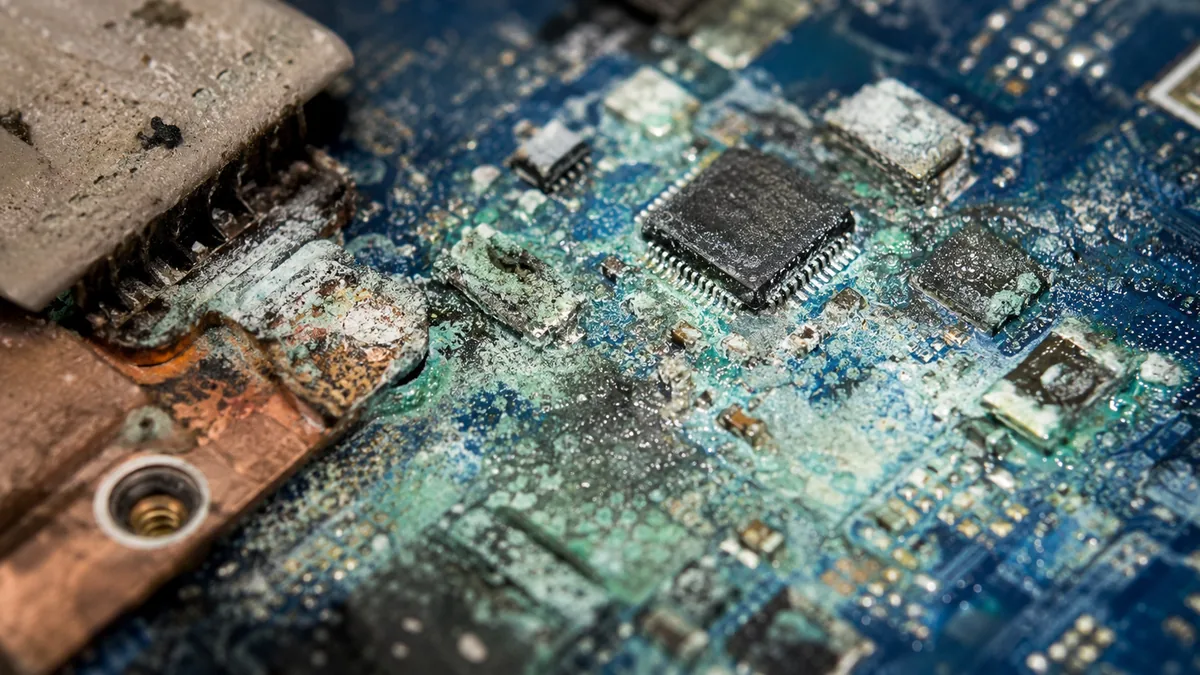
called electrochemical corrosion: wherever moisture bridges two points at different voltages, the current drives
a reaction that literally dissolves copper traces and eats the tiny legs off components. That reaction keeps
going for days, quietly, while the machine still switches on — which is exactly why so many laptops seem perfectly
healthy after a spill and then die suddenly three or four days later. The device you are still using is not safe.
It is corroding on the inside.
This is the single most important thing to understand about liquid damage, because it dictates everything about
the repair. The damage is not a moment; it is a process, and the process runs on time. Every hour the board sits
wet, or sits with power in it, or sits "drying out" in a bag of rice, is another hour the corrosion advances. That
is why our entire method is built around getting the board opened, cleaned and neutralised as fast as possible, and
why the best thing you can do the moment a drink goes over your keyboard is not to test whether it still works —
it is to shut it down and get it to a bench. Water damage repair is really corrosion-arrest and corrosion-reversal:
we stop the chemical reaction, then undo as much of what it has already done as the board will allow.
The other half of the problem is what the liquid was. Not all spills are equal. Plain water is the least awful,
though "least awful" still means real damage. Coffee, tea, soft drinks, juice, beer and — worst of all — sweet,
milky drinks leave behind a sticky, sugary, conductive residue that keeps bridging pins and rotting traces long
after the wet itself has evaporated. A board that has had teh tarik spilled on it is a far harder rescue than one
that met a splash of mineral water, because the sugar and acids carry on corroding invisibly. Whatever the liquid,
though, the correct first move is identical, and it is the opposite of what instinct tells most people to do.
First aid: what to do in the first hour after a spill
What you do in the first hour matters more than anything we do afterwards, because it decides how much board is
left for us to save. These steps are safe to do yourself and buy us the best possible starting point:
Power it off immediately — hold the power button. Do not shut down through the menus and
wait. Press and hold the power button until the machine goes fully dark. Cutting power stops the current that
drives the corrosion.
Unplug the charger and any accessories. Disconnect the adapter, USB devices and anything
plugged in. You want zero voltage anywhere near the wet board.
Do not turn it back on to "test" it. This is the mistake that finishes off recoverable
machines. Every power-on with liquid inside invites a fresh short across a bridged rail. Resist the urge to
check if it still works — assume it does not.
Do not use rice, and do not use a hairdryer. Rice cannot pull liquid from a sealed chassis
and does nothing about corrosion; it only wastes the critical early days. A hairdryer pushes moisture deeper and
can heat-stress components and adhesive.
Tent it keyboard-down on a towel. Close to a 45–90° angle, screen and keyboard facing down
over a dry towel, so gravity draws liquid away from the board rather than pooling on it. Do not try to pry the
machine open yourself.
Bring it in the same day. This is the step that changes the outcome. The board needs a
proper strip-down and clean before the corrosion spreads. Message us a photo on the way and we will have a bench
ready.
If you cannot get to us on the day, keep it off, keep it tented, and get it to us as early as you can the next
morning. Do not be reassured if it still switches on — a working machine after a spill is a machine on a clock. If
it will not power on at all, see our guidance on a laptop that won't turn on,
but the liquid response above still comes first.
Laptop Water Damage Repair Singapore
The symptoms that point to liquid damage
Liquid faults show up in a handful of recognisable ways. Because the corrosion spreads, the same machine can move
from one symptom to a worse one over days — which is the strongest argument for acting early:
Dead the instant it was spilled on. A drink hit a live board and shorted a rail across
bridged pins. Sometimes a full clean brings it straight back; sometimes a component took the hit and needs
replacing.
Worked at first, then died days later. The classic, and the hardest. It powered on fine after
the spill, so it went un-cleaned, and the corrosion quietly ate a trace until a rail finally failed.
Sticky, stuck or dead keys. Residue under the keyboard membrane. On many laptops the keyboard
is a wear part; on a MacBook it sits directly over the logic board, which raises the stakes.
Turns on, then random shutdowns or freezes. Corroded contacts making and breaking as the
machine warms and moves. Intermittent liquid faults are the ones that get worse if left.
Will not charge, or charges only sometimes. Liquid at the DC-in jack or charge circuit,
corroding the very components that manage power in.
Screen artefacts, dim backlight or no image. Liquid tracked to the display connector or the
backlight circuit, or corrosion on the graphics power delivery.
Send us a two-line description and a photo before you travel; from the symptom and what was spilled we can usually
give you an honest read on the likely damage and a price band.
Common liquid damage faults, and what causes them
Below is the bench reference our technicians use during a liquid intake. The reference codes are ours, not an
industry standard — quoting one over WhatsApp simply lets us prepare the right bench and cleaning setup before you
arrive. Turnaround assumes the corrosion behaves the way the symptom suggests; a liquid board always needs its
soak-test time before we call it done.
Diagnostic reference
Liquid damage fault reference
The faults that account for most spill repairs on our bench, in roughly the order we see them.
RefSymptomMost likely causeTypical turnaround
LIQ-01Dead the moment it was spilled onShorted rail from liquid bridging live pins3–7 days
LIQ-02Worked, then died days laterProgressive electrochemical trace corrosion3–7 days
LIQ-03Sugary drink, sticky everywhereConductive residue bridging pins and pads3–7 days
LIQ-04Sticky, stuck or dead keysResidue under the keyboard membrane1–3 days
LIQ-05Plugged in, not chargingCorroded DC-in jack or charging circuit2–5 days
LIQ-06Turns on, then random shutdownsIntermittent corroded contacts and vias3–7 days
LIQ-07No display or dim, flickering backlightLiquid at display connector or backlight rail3–7 days
LIQ-08Beyond economical board repairWidespread corrosion — data recovery route2–5 days
Just spilled something? Tell us now.
Power it off, keep it off, and message us a photo of the machine and the spill. A technician replies with what to do next and an honest read on the odds before you even set off.
Our laptop water damage repair process, step by step
Every liquid board follows the same disciplined path. A spill rewards speed and thoroughness and punishes any
shortcut — a board that is "cleaned" superficially and rushed back together is a board that dies again a week later.
This is the full sequence:
Full disassembly, battery out first. The machine comes completely apart and the battery is
disconnected before anything else, because as long as the battery feeds the board, corrosion has power to keep
working. Every module — mainboard, daughterboards, keyboard, trackpad, flex cables — is separated.
Microscope inspection of every board and flex. Under a stereo microscope at 20–40× we map
exactly where the liquid travelled and where corrosion has taken hold. We photograph it, so you see the real
state of the board rather than take our word for it.
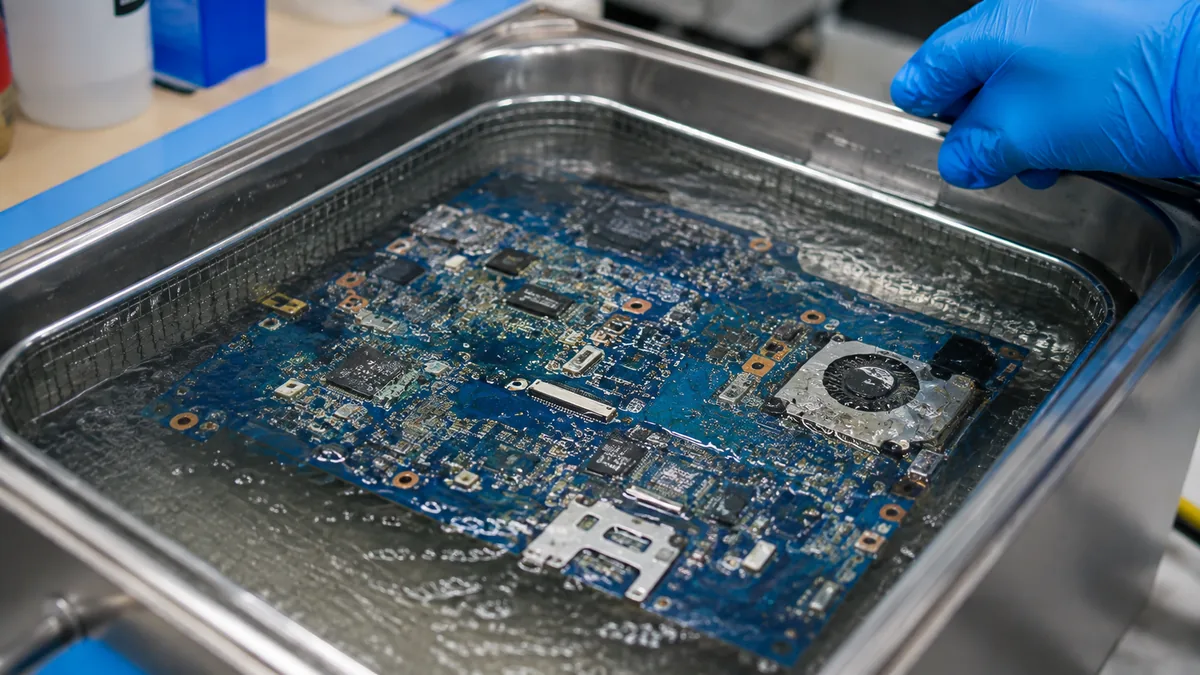
Ultrasonic clean and isopropanol. The affected boards go through an ultrasonic bath that
lifts residue and corrosion out of places a brush can never reach, followed by high-purity isopropanol to flush
and displace the last of the moisture and contamination.
Clear corrosion back to copper, re-tin the pads. Where corrosion has eaten into pads and
component legs we clean it back to bright copper and re-tin the pads with fresh solder, so there is a clean,
conductive surface to build on again.
Jumper broken traces, replace shorted components. Traces the corrosion has eaten through are
bridged with fine enamelled wire under the microscope; components that were shorted or destroyed are removed and
replaced with matching parts.
Power on a bench supply. The repaired board goes onto a bench power supply set to its rated
input, with the current limit clamped low, so we can read exactly what it draws and confirm the rails come up
cleanly before it ever goes back into the chassis.
Soak-test for 24 hours or more. A liquid board that passes a quick test is not proof of a
lasting repair — hidden corrosion can go quiet and return. So the reassembled machine is load- and soak-tested
for a minimum of 24 hours before it is handed back with a written warranty on the job sheet.
Two honest limits sit at the front of every liquid quote. First, some boards arrive with corrosion so widespread —
usually the ones that ran for a week or more after the spill — that a full recovery is no longer economical against
the value of the machine, and we will tell you that on day one rather than after you have paid. Second, when a board
is genuinely beyond saving, the job becomes a data question: the storage usually survives, and our
water damage data recovery service can recover your files even
from a machine that will never boot again. Deciding between reviving the board and simply
repairing or replacing the laptop is a conversation we have with you
before any money is spent.
The honest odds — and why timing decides them
We would rather be straight with you than sell false hope, so here is how the outcomes actually break down by how
long the board sat before it reached us. Bring a spilled laptop in the same day, powered off and
untested, and the odds of a strong recovery are genuinely good — the corrosion has had little time to spread and a
thorough clean often reverses most of the damage. Leave it a week of intermittent use, switching it
on to check whether it still works, and the odds fall sharply: every power-on drives more corrosion and every day
lets the residue eat deeper. Leave it a month, and the job very often stops being a repair at all
and becomes a data recovery exercise, because the board has been
eaten past the point of economical rescue.
The two things that ruin recoverable laptops. The first is turning it back on to test it —
every power-on with liquid inside invites a fresh short and drives more corrosion. The second is rice. Rice does
not draw liquid out of a sealed laptop, does nothing about the corrosion already forming on the board, and simply
burns the days that matter most while dust and starch work into the ports. There is no home drying trick that
reverses corrosion. The only thing that helps is a proper strip-down and clean, and the sooner it happens the more
of your laptop survives.
None of this means a machine that sat a while is automatically a write-off — we have brought back boards that
looked hopeless. It means the honest starting odds are lower, the bench time is longer, and the cost climbs, and you
deserve to know that before you decide. Whatever the state it arrives in, the diagnosis is free and you get a written
quote before any work begins; if we cannot recover it, you do not pay a repair fee.
Laptop Water Damage Repair Singapore
Preventing the next spill
Most liquid damage we see was, in hindsight, one small habit away from never happening. A few simple rules keep a
laptop clear of the most common — and most expensive — accident there is:
Keep drinks off the desk the laptop is on. A mug on a separate side table, out of arm's-sweep
range, is the single most effective change. Most spills are a knocked elbow, not a dropped glass.
Do not eat or drink over the keyboard. The keyboard sits directly over the board on many
machines, especially MacBooks, so a spill there goes straight to the worst place. If you must have a drink nearby,
use a bottle with a screw cap rather than an open mug.
Be extra careful with sweet and milky drinks. Coffee, bubble tea and soft drinks do far more
lasting harm than water because of the sugar residue. Treat them as the real hazard they are around electronics.
Mind the bag. A leaking water bottle in the same compartment as a laptop is a slow-motion
spill. Carry liquids in a separate pocket or a sealed pouch.
Back up regularly. A spill can take a laptop in seconds. A recent backup turns that from a
disaster into an inconvenience, whatever happens to the hardware.
If it does happen, act, do not wait. Power off, keep it off, tent it and bring it in the same
day. Speed is the one variable entirely in your hands, and it matters more than anything else.
Why customers trust us with a liquid rescue
Because we show you the corrosion under the microscope and photograph it, so you see the real state of the board
rather than take a verdict on faith. Because the quote is written before any work starts and does not move afterwards.
Because we are honest about the odds from the first minute — including when the honest answer is that the board is not
worth saving and the sensible route is board-level repair only
if it makes economic sense, or data recovery if it does not. Every completed repair carries a written warranty on
parts and workmanship, and if we cannot recover the machine you do not pay a repair fee. On a liquid job, where a
quick clean can hide a board that is about to fail again, that honesty and the discipline of a full soak-test are
worth more than any shortcut.
Verified Google reviews
Liquid rescues, in customers' words
Every review below is a real, unedited review from our Google profile, shown with the customer’s name as they left it. Read all 940+ on Google.
★★★★★
I had MacBook motherboard water damage during my mandatory SHN, a very stressful situation. iDevice Repair helped me to get up and running in less than a week, during the holiday season, and even arranging for delivery of my MacBook since I was located 5 minutes away.
★★★★★
I have brought my Macbook Pro to them to fix my water damage. They are very responsive and the price is much more affordable than apple. I am glad to have my motherboard fixed. Thanks for the service. It took around 1 week, which is quite fast. Thanks for the service
★★★★★
Was able to fix water damage/ motherboard issue in around 1 week, service was good as well.
★★★★★
Great customer service! They repaired my Macbook Pro that couldn’t turn on because of water damage.
What laptop liquid damage repair costs in Singapore
Spills are quoted after teardown, because the price follows how far the liquid travelled and what it corroded rather than how much went in. These are the bands the work falls into:
Repair
Our band (SGD)
What drives the price
Liquid damage service
From around $120 to $800
How far corrosion has spread; how many components need cleaning or replacing
Motherboard / board-level repair
From around $120 to $800
Which component failed; microsoldering bench hours
Keyboard replacement
From around $25 to $480
Keycap fix vs full module vs a keyboard bonded into the top case
Battery replacement
From around $110 to $380
Cell type; bolt-in pack vs adhered internal cell
Our figures are bands, not quotes — the exact price depends on the model and what the diagnosis finds, and you get a written quote before any work starts. Apple prices where shown were read from Apple’s official Singapore service estimator on 16 August 2026 and are for comparison only; Apple states it will inspect the device to determine the final fee, that a delivery fee may apply, and that Apple Authorised Service Providers set their own fees.
The clock matters more than the spill
Corrosion keeps working long after the laptop looks dry, so the difference between bringing it in today and next week is often the difference between a clean and a board repair. Do not try to dry it with heat, and do not keep powering it on to test.
My laptop still works after a spill. Do I really need to bring it in?
Yes, and quickly. A laptop that seems fine after a spill is the most dangerous case of all, because liquid does not kill a board with one clean short — it starts a slow electrochemical corrosion that keeps eating copper traces and component legs for days while power is still flowing. Machines that worked for a week and then died suddenly are the ones we struggle most to save. Power it off, keep it off, and bring it in the same day so we can clean the board before the corrosion spreads.
Should I put my laptop in rice to dry it out?
No. Rice is a myth that costs people their laptops. It cannot pull liquid out of a sealed chassis, it does nothing about the corrosion that is already forming on the board, and the days you spend waiting for it to "dry" are exactly the days the damage gets worse. Rice dust and starch can also work into ports and connectors. The only thing that helps is a proper strip-down and clean under a microscope, and the sooner that happens the better the outcome.
Is coffee, tea or juice worse than plain water?
Much worse. Plain water is bad enough, but sugary and acidic liquids — coffee, tea, soft drinks, juice, beer — leave behind a sticky, conductive residue that keeps corroding the board long after the wet has gone, and that residue is what bridges pins and rots traces. Milk and sweet drinks are the hardest of all to clean. Whatever the liquid, the response is the same: power off, do not test it, and get it to us for an ultrasonic clean while the residue is still soft.
How much does laptop water damage repair cost in Singapore?
Liquid repair is priced by how far the corrosion has spread and how much bench time it takes to reverse, not by the part, because the part is usually a few dollars. A board caught early that only needs a full clean and a keyboard or trackpad sits in the lower bands; a board with shorted components, corroded traces to jumper and a soak-test runs higher. We open the machine, assess the corrosion under the microscope, and give you a written quote you approve before any work starts. Diagnosis is free, and if we cannot recover it you do not pay a repair fee.
How long does liquid damage repair take?
Plan for three to seven working days. A liquid board is not a fixed-duration job — it needs a full disassembly, an ultrasonic clean, drying, corrosion clearing and then a minimum 24-hour soak-test to prove the fault has not simply gone quiet and will return. We never rush a liquid board back into its chassis the same afternoon, because a board that looks alive after a quick clean can die again days later if hidden corrosion was missed. We update you the moment we know what the real damage is.
The board is beyond repair. Can I still get my files back?
Usually, yes. Even when a board is too far gone to bring back to life economically, the storage is often untouched, because the drive sits away from where most spills land. We can remove or read the SSD or hard disk and image it on write-blocked hardware so nothing more is written to a failing device. Where the storage is soldered to the board, our water damage data recovery process works at chip level. Losing the laptop does not have to mean losing the data.
Do you repair water-damaged MacBooks as well as Windows laptops?
Yes. We handle liquid damage on every major brand — Dell, HP, Lenovo, ASUS, Acer, MSI and the rest — and on MacBook Air and Pro, which are especially spill-prone because the keyboard sits directly over the logic board. The method is the same on all of them: disconnect the battery, strip the machine down, clean and inspect every board and flex under the microscope, clear corrosion, replace shorted parts and soak-test. We are an independent workshop and are not affiliated with or authorised by Apple or any other brand.
Bring the spilled laptop in today — the odds are best now
Walk-ins welcome from the CBD, Orchard, Novena, Toa Payoh, Bishan, Ang Mo Kio, Jurong East, Clementi, Tampines, Bedok, Woodlands, Yishun, Hougang and Punggol. Islandwide courier collection for machines that should not be moved. Free diagnosis, written quote, no fix no fee.