

Buying & education guide · Singapore
The laptop maintenance checklist for Singapore
A laptop rarely dies all at once. It slows down, runs hot, loses battery life and fills up quietly over months — and almost all of that is preventable with a light routine. This checklist sets out exactly what to do weekly, monthly, quarterly and once a year, tuned for Singapore's heat, humidity and dust. Everything here is safe to do yourself; the machine stays closed.
Weekly, restart the laptop, install updates, empty the bin, back up and wipe the screen and keyboard. Monthly, check free storage, prune start-up apps, clear browser clutter, look at battery health and run an antivirus scan. Quarterly, clean the vents from the outside, check for dust build-up, update drivers and test that a backup actually restores. Once a year, book a professional thermal service and repaste, a battery check, a deep clean and an SSD health check. Keep the machine cool, off soft surfaces and away from liquids. In Singapore's climate, heat and dust are the two things to stay ahead of — everything else follows from that.
On this page
Weekly: the five-minute routine
The weekly tasks are the ones that keep small problems from becoming big ones. None of them takes long, and together they cover the two things that matter most week to week: your machine staying responsive, and your files staying safe. Run through this list once a week — a quiet moment on a Sunday evening works well.
- Restart the laptop properly. Closing the lid is not the same as a restart. A full reboot clears memory, applies pending updates and resets the small glitches that build up when a machine runs for days on end. If yours has felt sluggish, this alone often fixes it.
- Install pending updates. Let Windows Update or macOS install operating-system and security patches, and update the apps you rely on. These patches close security holes and fix bugs; leaving them for months is how machines become both slow and vulnerable.
- Empty the recycle bin or trash. Deleted files are not gone until the bin is emptied, and on a nearly full drive they quietly hold back space you need.
- Back up your files. This is the single most important habit on the whole list. Let your cloud sync finish, or copy your important folders to an external drive. Hardware can fail without warning, and a current backup turns a disaster into an inconvenience. If a drive has already failed, professional data recovery is often possible, but a backup is far cheaper and less stressful.
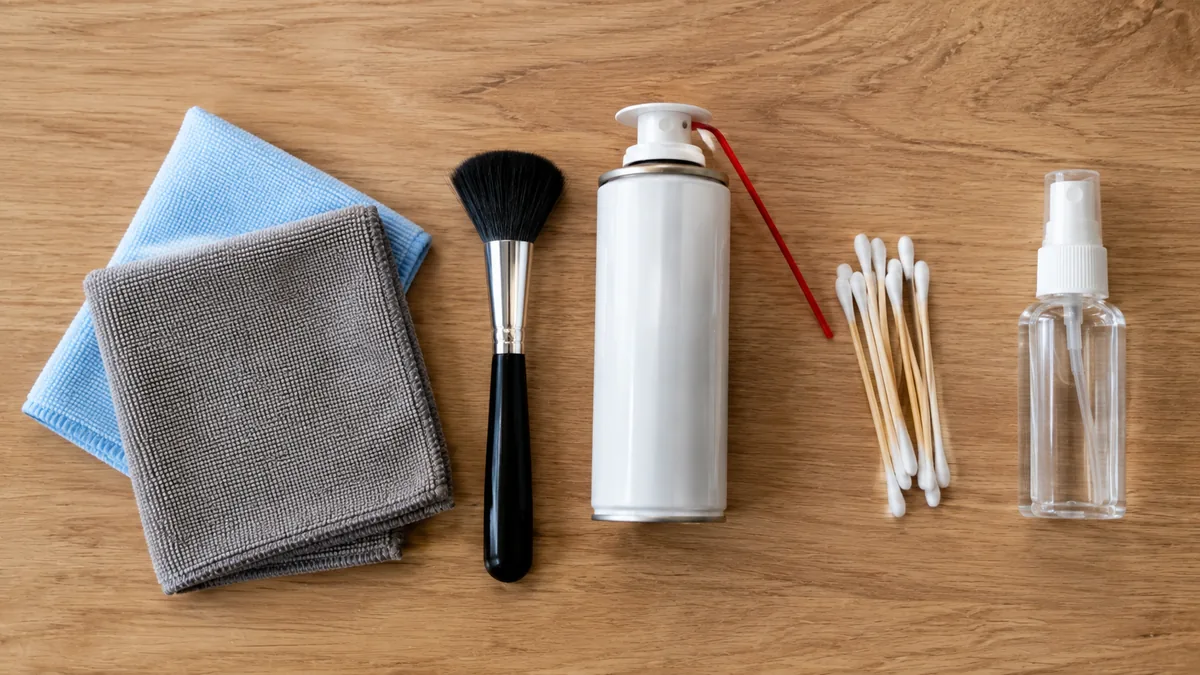
- Wipe the screen and keyboard. Use a barely damp microfibre cloth on the screen and a dry or only slightly damp one on the keyboard and palm rest. Never spray liquid directly onto the laptop. This keeps oils and grime from building into the keys and hinges. For the full method, see our guide on how to clean your laptop safely.
Monthly: a deeper check
Once a month, spend fifteen minutes looking a little deeper. These checks catch the slow drifts — a filling drive, a growing pile of start-up programs, a battery quietly losing capacity — before they turn into a machine that feels tired. Set a recurring reminder so it does not slip.
- Check your free storage space. A drive that is nearly full slows the whole system and, on an SSD, shortens its life. Aim to keep at least ten to fifteen per cent free. If you are constantly bumping against the limit, it may be time for a bigger SSD upgrade rather than a monthly fight for space.
- Review your start-up apps. Every program that launches at boot slows your start-up and eats memory in the background. On Windows, open Task Manager and look at the Start-up tab; on a Mac, check Login Items in System Settings. Disable anything you do not need running from the moment you switch on.
- Clear browser clutter. Browsers accumulate cache, extensions and dozens of open tabs that together consume more memory than most people realise. Clear the cache, remove extensions you no longer use, and close tabs you have been hoarding. This is one of the quickest wins for a machine that feels slow.
- Check your battery health. On Windows, run
powercfg /batteryreportfrom a command prompt to see full-charge capacity against the original design capacity. On a MacBook, look at Battery Health in System Settings. Watch the trend over months, and read our guide on how to protect your laptop battery for habits that slow the wear. - Run an antivirus or malware scan. A full scan with Windows Security or a reputable tool catches anything that has slipped through. Malware is a common and overlooked cause of a laptop that has become slow, hot or unstable for no obvious reason.

Quarterly: dust, drivers and backups
Every three months, do the tasks that keep the hardware and your safety net healthy. This is where Singapore's climate really earns its place on the checklist — dust and heat are relentless here, and a quarterly rhythm keeps them from compounding.
- Clean the vents and keyboard. With the laptop switched off, use short bursts of compressed air held upright, from a small distance, to move loose dust off the intake and exhaust vents and out from between the keys. Do not push the nozzle into the vents or spin the fan with air. This clears what you can reach from the outside; the internal dust is a job for the yearly service.
- Check for dust build-up. Look at the vents in good light. If you can see a felt-like mat of dust across the mesh, or the fan has grown noticeably louder and the machine hotter, the inside needs attention. In Singapore's humid air, dust clings and packs down faster than in a cooler, drier climate, so this check matters more here than the manuals from overseas assume.
- Update your drivers. Graphics, chipset and other drivers get fixes for stability, performance and, sometimes, thermal behaviour. Use your laptop maker's own support tool or Windows Update rather than random driver-updater programs, which often do more harm than good.
- Verify that a backup restores. A backup you have never tested is only a hope. Once a quarter, open a file or two from your backup, or do a small test restore, to confirm the data is really there and readable. Plenty of people discover a broken backup only at the worst possible moment.
Yearly and as needed: the professional service
Some maintenance needs the machine opened, and that is where DIY should stop and a technician should take over. Opening a laptop means releasing fragile clips, disconnecting ribbon cables and handling static-sensitive parts — easy to get wrong, and expensive when it goes wrong. Book these once a year, or sooner if something below flags up.
- Professional thermal service and repaste. Over a year, the thermal paste between the processor and heat sink dries out and the internal fins pack with dust that outside cleaning cannot reach. A proper service strips the cooling system, cleans it fully and applies fresh paste, which is often the single biggest cure for a laptop that has become hot, loud and slow. See our laptop fan and thermal service for how we do it.
- Battery check. Have the battery health assessed and the cell replaced if it has worn down or, importantly, if it has swollen. A swollen battery lifts the trackpad or case and is a genuine safety issue — stop using it and have it dealt with promptly rather than leaving it in the machine.
- Deep clean. A full internal clean clears the dust, lint and grime that build up around the fan, the ports and under the keyboard over a year of Singapore weather, restoring airflow the outside cleaning cannot.
- SSD health (SMART) check. Drives report their own health through SMART data — wear level, reallocated sectors, error counts. Checking it once a year catches a drive that is quietly heading towards failure while there is still time to back up and replace it, rather than after it has taken your files with it. Pair this with a fresh look at your backups.
The theme across all of these is the same: the routine, external tasks are yours to own week to week, and the once-a-year internal work is ours. You never need to open the machine yourself to keep it healthy.
Due for a yearly service? We will keep it cool.
A professional thermal service, deep clean, battery check and SSD health report — everything on the yearly list, done safely on the bench. Walk in, or send a photo and a description and we will tell you what your machine needs.

Physical care: how you handle it
How you treat a laptop day to day matters as much as any scheduled task. Most of the machines that reach our bench with early failures were not unlucky; they were run hot on a bed, carried loose in a bag, or kept next to a drink. A few simple habits prevent the majority of avoidable damage:
- Keep it cool and off soft surfaces. Laptops draw cooling air through vents on the base and sides. Using one on a bed, sofa, cushion or lap blocks those vents, traps heat and makes the fan work harder for less airflow. Use it on a hard, flat surface, or a lap desk or cooling stand, so air can move freely underneath. In Singapore's warm rooms this is the easiest heat win there is.
- Keep liquids away from it. A knocked-over drink is one of the most common and most destructive accidents we see, and liquid damage on a laptop is expensive and sometimes fatal. Keep cups and bottles off the same surface, and if a spill does happen, switch the machine off immediately, unplug it, turn it upside down to drain, and bring it in — do not try to power it on to check if it still works.
- Use a sleeve or padded bag. When the laptop travels, a padded sleeve protects it from knocks, pressure and the scrapes that crack screens and dent chassis. Slot it in with the lid closed and nothing resting on top.
- Handle the lid by the base. Open and close the laptop from the centre of the front edge, not by a corner, and never pick the whole machine up by its screen. Corner stress and lid-lifting are a leading cause of failed hinges and cracked panels, and a hinge that starts to bind will slowly tear the display cable if it is ignored.
- Mind humidity and airflow. Do not store a laptop in a sealed, damp space for long periods, and give it a little breathing room rather than boxing it in. Singapore's humidity is hard on electronics over time, so a cool, dry, ventilated spot is kinder than a hot cupboard.
Software housekeeping that keeps it fast
Hardware care keeps a laptop alive; software care keeps it feeling quick. Alongside the weekly and monthly tasks above, a little ongoing housekeeping stops the gradual clog of programs and files that makes an older machine feel slower than it really is:
- Uninstall what you do not use. Every few months, go through your installed programs and remove the ones you have stopped using. They take up space, and some run background processes that quietly draw on memory and battery.
- Keep files organised and off the desktop. A desktop buried in files and a downloads folder that has never been cleared both slow things down and make backups larger and slower. File as you go, and clear downloads regularly.
- Manage your passwords and accounts sensibly. Use a password manager and keep your recovery details current. It is not performance maintenance, but it saves you the far bigger headache of being locked out after a repair or a reinstall.
- Do not over-clean. You do not need aggressive "PC cleaner" or "booster" tools — many are useless and some are harmful. The built-in tools, plus the habits on this page, do everything a healthy laptop needs. If your machine is slow despite all this, the cause is usually hardware, such as a tired drive or a thermal problem, and that is worth a proper look.
- Know when maintenance has run its course. A laptop that stays slow, hot or unstable after you have tidied the software and cleared the vents is telling you something the routine cannot fix. At that point a diagnosis is the sensible next step, and it is worth understanding how long a laptop should last so you can weigh a repair against its age.
Putting the checklist to work
None of this is complicated, and that is the point. The reason laptops fail early is almost never a single dramatic event; it is the slow accumulation of heat, dust, a full drive and a worn battery, none of which announces itself until the machine is already struggling. A light routine — five minutes a week, fifteen a month, a longer look each quarter, and one professional service a year — keeps all four in check and adds years of useful life for very little effort or cost. If you follow the way we approach repairs and servicing, you will recognise the same principle in our laptop repair process: catch the small thing early, and the big, expensive thing usually never happens.
Keep the external and software tasks as your own habit, and leave the internal work — the thermal service, the battery, the deep clean and the drive check — to us. Diagnosis is free on walk-ins, so if you are ever unsure whether something is normal wear or a fault worth acting on, it costs nothing to have us take a look before it becomes a bigger job.
Keep reading
Guides that keep your laptop healthy
How to clean your laptop safely
The right cloths, the right technique, and what never to spray near it.
Read the guide →How to protect your laptop battery
Charging habits that slow wear and keep runtime healthy for years.
Read the guide →How long should a laptop last?
What really determines a laptop's life, and how to stretch it.
Read the guide →Questions we get every week
Laptop maintenance — frequently asked questions
How often should I clean the inside of my laptop in Singapore?
For most people in Singapore, an internal clean and fresh thermal paste once a year is a sensible baseline, and every six months if you game, use the machine on a bed or sofa, live near a construction site, or keep pets. Our climate is warm, humid and dusty, so vents and fans clog faster here than in cooler, drier places. You do not need to open the laptop yourself to stay on top of this — the external and software tasks in this checklist do most of the work, and a professional thermal service handles the internal dust safely without risking cracked clips or a torn ribbon cable.
What laptop maintenance can I safely do myself at home?
Plenty, as long as you keep the laptop closed up. Safely restart it weekly, install updates, empty the recycle bin or trash, back your files up, and wipe the screen and keyboard with a barely damp microfibre cloth. Monthly, check your free storage space, review start-up apps, clear browser clutter, look at battery health and run an antivirus scan. You can also blow loose dust off the outside of the vents from a short distance. What you should not do is open the chassis, dismantle the fan, or spray liquid into the vents — that is where DIY causes damage, and it is exactly the part we handle for you.
Why does my laptop get so hot and dusty in Singapore?
Singapore sits close to the equator, so ambient temperatures and humidity are high all year, and there is no cool season to give a laptop's cooling system a break. Warm, moist air carries more dust and it sticks more readily, so the fine mesh over the fan and the fins of the heat sink clog steadily. As that layer builds, airflow drops, the fan spins louder, and the processor throttles to protect itself, which shows up as heat, noise and slowdown. Regular cleaning of the vents from the outside slows it down, and a yearly internal thermal service clears what you cannot reach.
How do I check my laptop battery health?
On Windows you can open a command prompt and run powercfg /batteryreport, which saves a page showing the design capacity against the current full-charge capacity — the gap between the two is your wear. On a MacBook, hold Option and click the battery menu, or open System Settings and look at Battery Health for a Normal or Service reading, plus the cycle count in System Information. A battery that holds well under its original capacity, drops charge quickly, or has visibly swollen and lifted the trackpad or case is due for replacement. A swollen battery is a safety issue and should be dealt with promptly rather than left in service.
Does a regular maintenance routine actually make a laptop last longer?
Yes, and the effect is larger than most people expect. The two things that quietly kill laptops are heat and neglected storage, and both are addressed directly by this routine. Keeping the vents clear and the thermal system serviced stops the processor from cooking itself and the battery from ageing prematurely; keeping some free space on the drive and the software tidy keeps the machine responsive and reduces write wear on the SSD. A laptop that is kept cool, backed up and lightly maintained routinely reaches five to seven years of useful service, where a neglected one often struggles well before that.
When should I stop doing DIY maintenance and bring my laptop in?
Bring it in when the problem is inside the machine or when the routine tasks stop fixing it. Persistent overheating and fan noise after the vents are clear, a battery that reports Service or has swollen, a drive that is throwing errors or reporting bad SMART health, liquid that has gone anywhere near it, or a slowdown that a restart and a tidy-up no longer cure — these are all signs to book a professional look rather than push further at home. Diagnosis is free on walk-ins, so if you are unsure whether something is normal wear or a real fault, it costs nothing to have us check.
Keep it running longer. Let us handle the inside.
You own the weekly and monthly routine; we handle the yearly thermal service, battery check, deep clean and SSD health report. Free, no-obligation diagnosis on walk-ins — bring it in, or send a photo and we will tell you what it needs.