
Buying & education guide · Singapore
How to clean your laptop safely
A clean laptop looks better, runs cooler and lasts longer — but the wrong cloth, the wrong spray or one drop of liquid in the wrong place can do far more harm than the dirt ever would. This guide walks you through exactly what to use and how to clean every part of your machine safely, with the humidity and dust of Singapore in mind. No opening the laptop, no risky shortcuts.
Power the laptop off and unplug it first. Use a dry microfibre cloth for dust, and only ever dampen the cloth — never spray liquid onto the machine. Clean the screen with a lightly damp microfibre cloth using distilled water or a proper screen cleaner, never glass cleaner or ammonia. Use 70% or stronger isopropyl alcohol on a cloth for the keys, trackpad, palm rest and chassis. Blow dust from the ports and vents with short bursts of compressed air from the outside only. Keep every drop of moisture away from ports, vents and speakers, never poke anything metal inside, and never open the laptop yourself — heavy internal dust is a workshop job.
On this page
What you need to clean a laptop
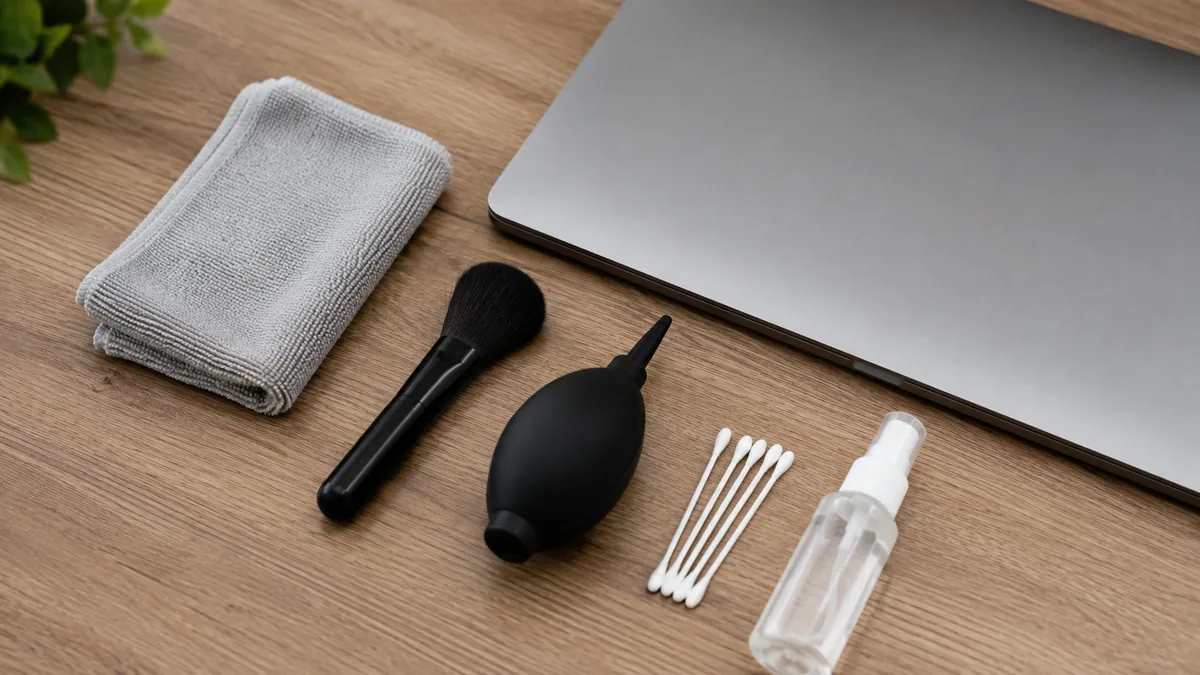
You do not need a special kit, and you certainly do not need harsh chemicals. A handful of inexpensive items, most of which you can buy from any pharmacy or hardware shop in Singapore, will let you clean every external surface of the machine safely:
- Two or three microfibre cloths. Soft, lint-free and gentle enough for a coated screen. Keep one dry for polishing and one for damp work. Avoid paper towels, tissue and old T-shirts — they are abrasive enough to leave fine scratches on a display.
- Isopropyl alcohol, 70% or stronger. The technician's default cleaner for keys, the palm rest and the chassis. It cuts grease, evaporates fast and leaves no residue. Anything weaker holds too much water; a higher concentration is fine.
- Distilled water or a proper screen cleaner. For the display specifically. Distilled water avoids the mineral spots that tap water can leave behind as it dries.
- A soft brush. A clean make-up brush or a soft paintbrush loosens dust from the keyboard, the vent grilles and the seams around the ports without scratching.
- A can of compressed air. The safe way to move dust out of the keyboard, the ports and the vents. Keep it upright and use short bursts.
- Cotton buds. For the tight spaces between keys and around the edges — lightly dampened with isopropyl alcohol, never dripping.
That is the whole list. Notice what is not on it: no household glass cleaner, no bleach, no all-purpose spray, no vacuum cleaner and no screwdriver. Every one of those causes more damage than it prevents, and we cover why below.
The golden rules that keep it safe
Before you touch a single surface, three rules matter more than any technique. Follow them and it is almost impossible to hurt the machine; break them and even a gentle wipe can turn into an expensive repair.
- Power off and unplug first. Shut the laptop down completely, disconnect the charger and, if the battery is removable, take it out. A powered machine can register stray key presses while you clean, and any moisture that reaches a live circuit can cause a short. Cleaning cold and dead is the single biggest safety step there is.
- Never spray liquid directly onto the laptop — dampen the cloth instead. Spraying puts droplets exactly where you cannot control them: into the seams around the screen, down between the keys and towards the vents. Always apply your cleaner to the cloth or cotton bud, wring it so it is barely damp, and bring that to the machine.
- Keep moisture away from ports, vents and speakers. These are the openings where liquid gets inside. Wipe around them, never over them, and if a port feels even slightly damp, stop and let it dry fully before you carry on or power back up.
Everything that follows is simply these three rules applied area by area. If you are ever unsure whether a surface is too wet, it is — a properly damp cloth should leave no visible film and should dry within a few seconds.
Cleaning the screen
The display is the part people most want to clean and the part most often damaged in the attempt. Modern laptop and MacBook panels carry delicate anti-glare and anti-reflective coatings, and the wrong chemical strips them permanently, leaving cloudy patches that no repair can polish out. Treat the screen as the most fragile surface on the machine.
- With the laptop off, start with a dry microfibre cloth and wipe gently in one direction to lift loose dust. Do not press — dust dragged under pressure is what scratches.
- For fingerprints and smudges that stay, lightly dampen a fresh part of the cloth with distilled water or a dedicated screen cleaner. The cloth should feel barely moist, never wet.
- Wipe gently in slow, straight strokes or small circles, working from the centre outwards. Let the panel dry completely before you close the lid, so no moisture is trapped against the keyboard.
Never use household glass cleaner, ammonia-based sprays, bleach or acetone on a screen — these are made for bare glass, not coated panels, and they cloud the coating fast. And never spray anything onto the display itself; the liquid runs straight down into the bezel and the hinge. If your screen already shows scratches, cloudy patches or dead pixels that cleaning will not fix, that is a hardware issue rather than a dirt one, and our screen replacement page explains the options.
Keyboard, trackpad and chassis
The keyboard and palm rest collect the most grime because your hands are on them all day, and in Singapore's climate that means oils, sweat and the fine grit that settles on every desk. The good news is these surfaces are far more robust than the screen, so isopropyl alcohol is your friend here.
The keyboard
- Hold the laptop at an angle and use short bursts of compressed air across and between the keys to blow out crumbs and dust. Aim the nozzle at an angle so debris is pushed out, not driven deeper under the keys.
- Loosen anything stubborn with a soft brush, then blow again.
- Wipe the key tops with a barely-damp microfibre cloth, or a cloth with a little isopropyl alcohol on it. Do not soak the keyboard and never let liquid pool between the keys — the electronics sit directly beneath them.
The trackpad
The trackpad cleans up beautifully with a microfibre cloth lightly dampened with isopropyl alcohol. Wipe in small circles to lift the skin oils that make it feel sticky, then buff dry. A clean trackpad tracks far more smoothly, and it takes only a few seconds.
The chassis and palm rest
For the lid, the palm rest and the underside, a microfibre cloth with a little isopropyl alcohol removes marks and grease and dries almost instantly. Work the cloth into the seams and around the edges, and use a cotton bud dampened with alcohol for the tight corners and the strip around the trackpad button. Keep the cloth away from the speaker grilles and any vents — wipe up to them, not across them. If a spill has left keys sticky or unresponsive rather than merely dirty, cleaning will not restore them and you may need a keyboard replacement.
Ports, vents and fans
Dust in the charging port, the USB sockets and especially the cooling vents is what quietly turns a fast, quiet laptop into a hot, throttling one. Clearing it is worthwhile — but this is also where people do the most damage by reaching for the wrong tool, so go gently.
Ports
- Use compressed air only, in short bursts, to blow lint and dust out of the charging port, the USB and HDMI sockets and the headphone jack.
- Never put anything metal inside a port — no pins, paperclips, tweezers or screwdrivers. The contacts are thin and easily bent or shorted, and a bent charging-port pin often means a board-level repair rather than a quick fix.
- If a plug fits loosely or a cable no longer clicks in, the port may be worn rather than dirty; have it looked at rather than forcing it.
Vents and fans
The cooling vents are the intake and exhaust grilles, usually along the sides, the back or the underside. This is where Singapore's dust does the most harm, packing into the fine fins of the heatsink over time.
- Aim short bursts of compressed air into the vents from the outside, at an angle, so dust is pushed back out the way it came rather than driven further in.
- Hold the can upright and a few centimetres back, and keep the bursts brief so you do not force moisture from the can into the grille.
- If you can see the fan blades through a grille, hold them still with a cotton bud while you blow. Letting compressed air spin a fan too fast can over-speed it and wear the bearing.
Crucially, do not open the laptop to reach the fan. Heavy dust packed inside the heatsink cannot be cleared from the outside, and it needs a proper strip-down. If your machine still runs hot or loud after an external clean, that internal dust — and dried-out thermal paste — is the cause, and it is a job for a fan and thermal service. Our guide to why laptops overheat explains what is happening inside when this occurs.
A few habits cause most of the cleaning damage we see, so avoid all of them: no household glass cleaner, ammonia or bleach on the screen — they strip the coating for good. No spraying liquid onto the laptop; always dampen the cloth. No vacuum cleaner on or inside the machine — the airflow and nozzle can generate a static charge that damages components. Nothing metal poked into ports or vents. No soaking — a barely-damp cloth is as wet as anything should ever get. Do not clean while the laptop is on or plugged in. And do not open the laptop yourself to clean inside; that risks the screws, the connectors and the delicate ribbon cables, and it can void a warranty. When a clean needs to go deeper than the surface, that is exactly what a workshop is for.
When to call a professional
Surface cleaning keeps a healthy laptop looking and running well, but some problems live inside the case where a cloth and a can of air cannot reach. It is time to hand the machine to a technician when:
- The fan is loud or the laptop runs hot even after you have cleared the vents from outside. That points to dust packed in the heatsink and thermal paste that has dried out — a thermal service cleans both properly.
- Dust is visibly caked behind the grilles and compressed air no longer shifts it.
- Something has been spilled into the keyboard. Liquid inside needs opening up and cleaning before corrosion sets in — do not try to dry it out and keep using it.
- A port is loose, bent or full of debris that will not blow out.
A professional internal clean is done on an anti-static bench with the right tools, so the fan, heatsink and board are cleaned safely and the thermal paste is renewed — none of which surface cleaning can do. If you would rather keep your own maintenance simple and safe, our laptop maintenance checklist sets out an easy routine, and our guide to protecting your battery covers the other half of keeping a laptop healthy. For how our technicians handle internal work, see the laptop repair procedure. Not sure whether a wipe-down is enough or an internal clean is due? Send us a photo or drop by and we will tell you honestly.
Laptop running hot after a clean? Let us look inside.
If clearing the vents from outside has not helped, the dust is packed in the heatsink and the thermal paste has dried out. A free, no-obligation diagnosis tells you exactly what the machine needs before you spend anything.
Keep reading
Guides that keep your laptop healthy
Fan & thermal service
What an internal clean and fresh thermal paste actually fix, and when you need one.
Read the guide →Laptop maintenance checklist
A simple routine that keeps your machine fast, cool and reliable for years.
Read the guide →Why laptops overheat
What is happening inside when a laptop runs hot, and how to stop it.
Read the guide →Questions we get every week
Cleaning your laptop — frequently asked questions
What can I use to clean my laptop screen safely?
Use a clean, dry microfibre cloth for everyday dust and fingerprints, and for anything stubborn dampen the cloth very lightly with distilled water or a cleaner made specifically for screens. Never spray anything directly onto the panel and never use household glass cleaner, ammonia, bleach or a paper towel — modern laptop screens carry delicate anti-glare and anti-reflective coatings that ammonia strips and rough paper scratches. Wipe gently in one direction with the laptop powered off, let it dry fully, and only close the lid once no moisture remains.
Is it safe to use isopropyl alcohol on a laptop?
Yes, on the right surfaces and applied the right way. Isopropyl alcohol of 70% or higher is excellent for the keyboard keys, the palm rest and the outer chassis because it lifts grease and evaporates quickly without leaving residue. Always put the alcohol onto a microfibre cloth or cotton bud rather than onto the laptop, and keep it away from the screen, which has coatings that alcohol can damage on some panels. Never soak anything, never let liquid run towards a port or vent, and always clean with the machine powered off and unplugged.
How do I clean dust out of my laptop vents and fan?
From the outside only, using short bursts of compressed air aimed into the vents at an angle so dust is pushed out rather than deeper in. Hold the can upright, keep it a few centimetres back, and if you can see the fan blades hold them still with a cotton bud so the airflow does not spin them too fast and stress the bearing. Do not open the laptop yourself and do not use a vacuum cleaner, which can generate static. If the vents stay blocked or the machine still runs hot, the dust is packed inside the heatsink and needs a proper workshop strip-down and thermal service.
How often should I clean my laptop in Singapore?
A quick wipe of the screen, keyboard and chassis every week or two keeps grime from building up, and a more thorough external clean including the vents every one to three months suits most people. Singapore's humidity and fine dust mean grilles and fans clog faster here than in drier climates, so if you use the laptop on a bed, sofa or carpet, or in a dusty room, lean towards the shorter interval. An internal clean and fresh thermal paste is a separate job for a technician, and is usually worth doing every couple of years or whenever the machine starts running hot.
Can I clean my laptop while it is switched on?
No. Always shut the laptop down fully, unplug the charger and, if the battery is removable, take it out before you start. Cleaning a powered machine risks liquid reaching live circuitry, and a wet keyboard can register random key presses or trigger shortcuts while you work. Powering off also lets the surfaces cool, makes smudges and dust far easier to see against a dark screen, and means a stray drop of moisture has time to evaporate before you ever switch back on. Wait until everything is completely dry before powering up again.
When should I get a professional to clean my laptop?
Get a technician involved when the problem is inside the machine rather than on its surface. If the fan is loud, the laptop runs hot or throttles, dust is visibly packed behind the vents, or a drink has been spilled into it, that needs opening up safely — something best left to a workshop with the right tools and anti-static handling. A professional thermal service cleans the heatsink and fan properly and replaces the dried thermal paste, which surface cleaning cannot reach. If you are unsure, send us a photo or bring the laptop in and we will tell you whether a wipe-down is enough or an internal clean is due.
Time for a proper internal clean? We can help.
A free, no-obligation diagnosis gives you our honest read on whether your laptop just needs a wipe-down or a full thermal service. Walk in, or send a photo and we will tell you what we think before you spend anything.