
Troubleshooting guide · Singapore
Laptop USB port not working? Find out if it's one port or all of them
A USB port that has stopped reading your drive, mouse or charger is annoying, but the fix depends entirely on one question: is it just one port, or every port on the laptop? One dead socket usually means physical damage; all of them dead usually means a driver, a power setting or the board. This guide shows you how to tell, which fixes are safe to try at home, and when the port needs a technician.
First, work out how many ports are affected. Test the same device in every port, and a second device in the dead one — that tells you whether the fault is the port or the device. If only one port is dead, it is almost certainly physical (dust, bent pins or a loose socket) and needs a technician. If all ports are dead, try the free software fixes: reinstall the USB controllers in Device Manager, turn off USB selective suspend, and check USB is enabled in BIOS. Never poke metal into a port to clean it.
On this page
Why a laptop USB port stops working
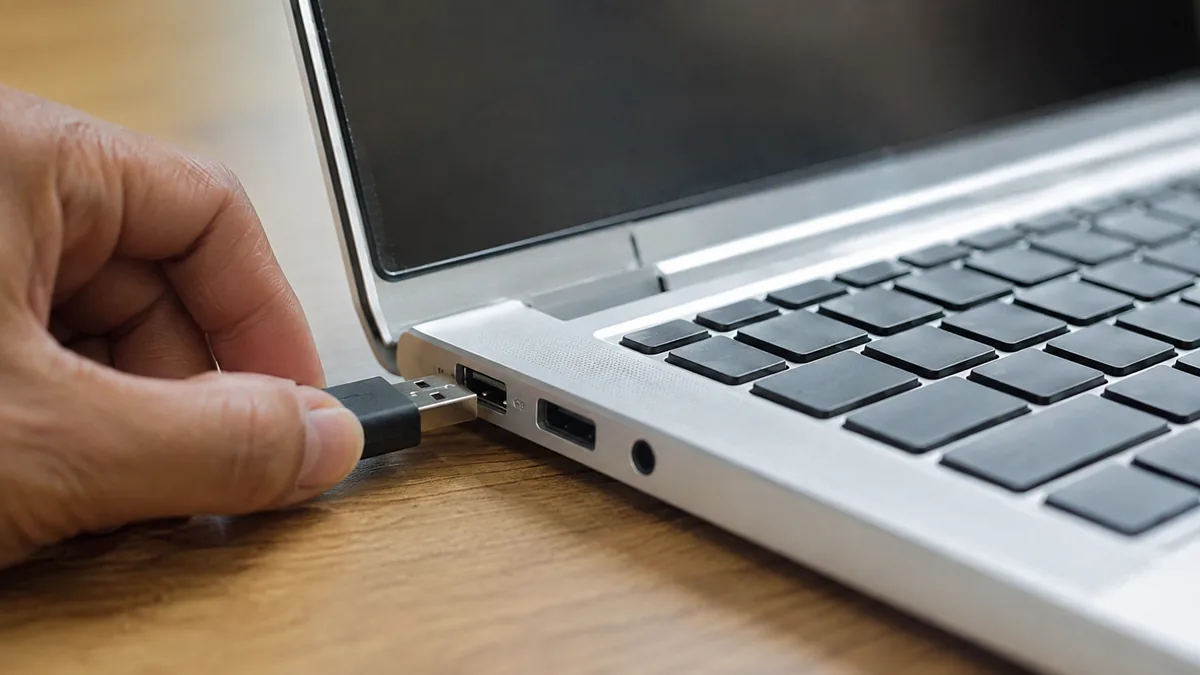
"USB port not working" sounds like one problem, but it splits neatly into three very different situations, and working out which one you have solves most of the puzzle before you touch a single setting. The single most useful thing you can do is count the ports. Plug the same known-good device — a mouse or a memory stick you know works — into every USB port in turn and note which ones respond. That one test tells you which of the following three patterns you are dealing with.
The first pattern is one port dead, the rest fine. When a single socket refuses to work while its neighbours are perfectly happy, the fault is physical and lives inside that one connector — a driver or a Windows setting would knock out several ports at once, not just one. The usual causes are dust or pocket lint packed into the slot, contact pins that have been bent or splayed by a plug going in crooked, or a socket that has cracked or worked loose from its solder joints on the board after years of cables being pushed in and yanked out. None of these is a Windows problem, and no amount of reinstalling drivers will bring the port back.
The second pattern is every port dead at once. It is very unlikely that all the sockets failed on the same morning, so a shared, non-physical cause is far more probable. That points to software or the board: a corrupt USB controller driver, Windows' USB selective suspend power-saving feature switching the ports off and failing to switch them back on, USB disabled in the BIOS, or — less often — a fault in the USB controller chip on the motherboard itself. The good news is that most of these are free to fix at home, and you should always try the software checks before assuming the worst.
The third pattern is a port that worked, then died the moment you plugged something in. That is the signature of an overcurrent trip. Every port has a small protection circuit that shuts it down if the attached device tries to pull too much power or has a short, sparing the rest of the board. A restart usually resets the trip and revives the port; if it stays dead, the protection component or fuse may have blown, or the device you plugged in was itself faulty. And underneath all three patterns sits one wildcard — liquid damage — where a spill corrodes the port or its traces and can affect one port, a cluster of them, or the whole board depending on where the liquid ran.
Match your symptom to the cause
Use this quick reference to see where your particular symptom is likely to sit, and whether it is something you can safely check yourself or something for a workshop.
Quick diagnosis
Symptom-to-cause reference
A guide, not a guarantee — the only way to be certain is to test the port on the bench and read the board, which is exactly what our free diagnosis does.
Not sure if it's one port or the board? Ask us.
Tell us the make, model, how many ports are dead and what happens when you plug a known-good device in. A technician replies with a probable cause and an honest price band before you travel — diagnosis is free on walk-ins.
Safe fixes you can try yourself
Work through these in order. They are all safe, none of them involves opening the laptop, and between them they clear a large share of USB faults — especially the ones where every port is dead, which are usually software. Stop at the first one that fixes it.
- Isolate the port from the device. This is the single most useful test and it costs nothing. Plug the same known-good device — a mouse or memory stick you are sure works — into each USB port in turn, and also plug a second, different device into the dead port. If the device works in other ports but nothing works in this one, the port is the problem. If nothing works in any port, the fault is shared — a driver, a setting or the board — not the sockets. Note which ports are affected; it changes everything that follows.
- Restart the laptop. A full restart — not sleep, not hibernate — clears a stuck USB state and resets a port that has tripped its overcurrent protection after you plugged something in. Shut down completely, wait ten seconds, and power back on. This is the quickest fix for a port that died the moment a device went in, and it fixes a surprising number of "all ports dead" cases too.
- Reinstall the USB controllers in Device Manager. If all ports are dead, this often revives them. Right-click the Start button, open Device Manager, expand "Universal Serial Bus controllers", right-click each "USB Root Hub" and "Host Controller" entry and choose Uninstall device, then restart the laptop. Windows reinstalls the controllers cleanly on boot, which clears a corrupt driver — a common cause after a Windows update.
- Turn off USB selective suspend. This Windows power-saving feature switches ports off to save battery and sometimes fails to switch them back on. Open Control Panel, go to Power Options, click "Change plan settings" then "Change advanced power settings", expand "USB settings" and "USB selective suspend setting", and set it to Disabled on both battery and plugged-in. This is the fix when ports only drop out on battery power.
- Check USB is enabled in the BIOS. Rarely, USB ports get switched off in firmware — often after someone else has been in the settings. Restart and tap the BIOS key for your model (commonly F2, F10, Del or Esc) as it powers on, look under an Advanced or Integrated Peripherals menu for a USB option, and make sure it is Enabled. Save and exit. Do not change anything else while you are in there.
- Gently clean the port — no metal. Dust and lint genuinely kill ports, and this is safe if you never insert metal. With the laptop switched off, give the socket a short burst of compressed air, or lift debris out with a wooden or plastic toothpick. Never poke a pin, paperclip, needle or knife into the port — metal bends the delicate contacts and can short the pins.
- Try an update or a powered hub as a stopgap. Check Windows Update for chipset or USB driver updates, and if you urgently need a working port in the meantime, a self-powered USB hub in a working port gives you extra connections without stressing the laptop. A hub is a workaround, not a repair, but it keeps you going until a damaged socket is fixed.
Never push a pin, paperclip, needle, tweezers or any metal object into a USB port to "clean" or "bend back" the contacts — metal bends the delicate pins and can short them, turning a simple clean into a soldering job. Do not force a plug that will not seat, do not keep jamming a device into a port that wobbles or feels loose, and do not keep using a port that got wet in a spill. If the socket is physically loose, cracked or damaged, stop — that is a workshop repair, not a home fix.

When to get professional repair
If you have run the software checks — reinstalled the USB controllers, disabled selective suspend, confirmed USB is on in the BIOS — and the ports are still dead, or if a socket is physically loose, wobbly or damaged, the fault has moved beyond anything you can safely fix at home. At that point the cause is usually one of three things, and each needs a workshop:
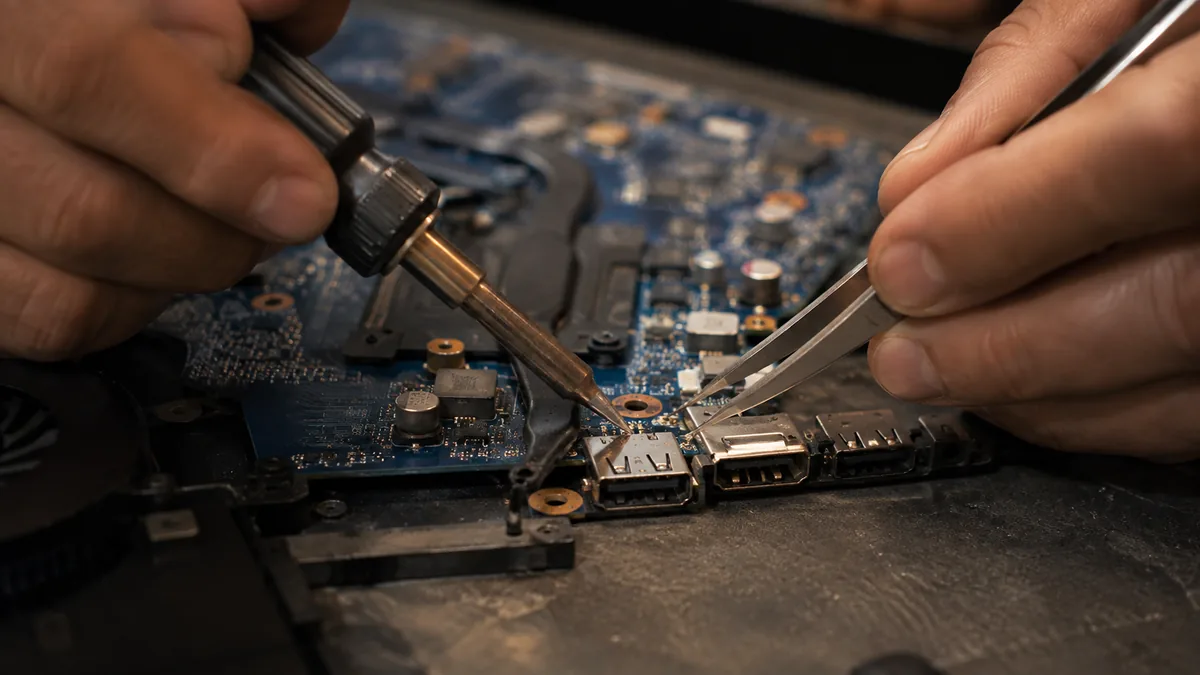
- A physically damaged or loose socket. A cracked USB connector, bent contact pins, or a socket that has come away from its solder joints stops that port working and often makes plugs wobble or fall out. This is a common, very repairable fault — the port is re-soldered back to the board or, if the connector itself is broken, replaced. It usually sits alongside our laptop charging port repair work, since both are board-mounted connectors that wear out the same way.
- All ports dead from a controller fault. When every port is dead and software has been ruled out, the USB controller or a shared power component on the motherboard has failed. Rather than replacing the whole board, our laptop motherboard repair service traces and fixes the actual failed component at board level — usually at a fraction of the cost of a new board.
- A blown port protection or fuse. A port that died after a device was plugged in and never came back after a restart may have blown its overcurrent protection or a fuse. That is a small, specific board-level repair once the failed component is identified.
A liquid spill is the one case where you should not wait at all. Liquid damages a board slowly through corrosion, so a port that stopped working after a spill needs a workshop the same day — see our liquid damage guidance. And if you use the USB ports to move important files off the laptop, do not rely on a failing port to do it — ask about data recovery instead, which reads the drive directly rather than through a suspect connector.
Whatever the cause, our diagnosis comes first and is free on walk-ins: we tell you which port is at fault, why, and what the repair costs before any work begins, and if we cannot fix it you do not pay a repair fee. Most dead USB ports are a small, contained repair rather than a dying laptop — it is almost always worth finding out which before you write the machine off. For anything else that is misbehaving, our general laptop repair service covers every brand, and for desktops and all-in-ones see computer repair. If you are working through a run of faults, our laptop WiFi not working and laptop keyboard not working guides follow the same approach.
Related repair services
If it turns out to be hardware
Motherboard repair
Failed USB controllers, blown port fuses and shorted rails traced and fixed.
See the service →Charging port repair
Loose and cracked board-mounted connectors re-soldered or replaced.
See the service →Laptop repair
Every make, component-level diagnostics and a written warranty on the job.
See the service →Questions we get every week
Laptop USB port not working — frequently asked questions
Why has one USB port stopped working while the others are fine?
When a single port is dead and the rest still work, the problem is almost always physical rather than software — the fault sits in that one socket, not in Windows or the drivers, because a driver problem would take out several ports at once. The usual culprits are dust or lint packed into the connector, bent or splayed contact pins from a plug going in at an angle, or a socket that has cracked or worked loose from its solder joints after years of cables being pushed in and pulled out. Test the same device in a different port to confirm the port is the problem, then have the loose or damaged socket re-soldered or replaced.
None of my laptop's USB ports are working — what does that mean?
When every port is dead at once, the fault is usually shared rather than physical, because it is unlikely that all the sockets failed on the same day. That points to a software or board-level cause: a corrupt USB controller driver, a Windows power-saving setting suspending the ports, USB disabled in the BIOS, or a fault in the USB controller on the motherboard itself. Start with the free software checks — reinstall the USB controllers in Device Manager, turn off USB selective suspend, and confirm USB is enabled in BIOS. If none of that brings the ports back, it is a board-level USB-controller fault and needs a workshop.
My USB port stopped working right after I plugged something in. Why?
A port that worked perfectly until you plugged a specific device in, then went dead, has usually tripped its overcurrent protection. Laptops fit each port with a protection circuit that shuts the port down if the attached device tries to draw too much power or has a short, which protects the rest of the board. A simple restart often resets the trip and revives the port. If the port stays dead after a reboot, the protection component or fuse may have blown for good, or the device you plugged in was faulty — test the port with a known-good device before assuming the port is damaged.
Can a Windows setting stop my USB ports from working?
Yes. Windows has a power-saving feature called USB selective suspend that switches ports off to save battery, and on some machines it fails to switch them back on, leaving ports that seem dead. Corrupt or outdated USB controller drivers can do the same. Both are free to fix at home: open Power Options and turn off USB selective suspend, then open Device Manager, uninstall the USB Root Hubs and controllers, and restart so Windows reinstalls them cleanly. If the ports come back after that, it was software all along and no parts were needed.
Is a broken laptop USB port worth repairing?
Usually yes, because a dead USB port is far more often a cheap, contained fault than a sign of a failing laptop. A loose or cracked socket can be re-soldered or replaced, and even a board-level USB-controller fault can normally be traced and repaired at component level rather than replacing the whole board. We diagnose the exact cause before quoting, so you get the repair figure and an honest read on the machine before you decide — and a USB port repair almost always costs a fraction of a new laptop.
Is it safe to clean a USB port myself?
Cleaning is safe only if you never put metal into the port. Dust and lint are a genuinely common cause of a dead-feeling socket, and you can clear them with the laptop switched off, using a short burst of compressed air or a wooden or plastic toothpick to gently lift debris out. Never poke a pin, paperclip, needle or knife into the port — metal bends the delicate contacts and can short the pins, turning a five-second clean into a soldering job. If the port feels loose, wobbly or looks physically damaged, do not try to fix it yourself; that needs a technician.
Bring it in for a free diagnosis
Walk-ins welcome from the CBD, Orchard, Novena, Toa Payoh, Bishan, Ang Mo Kio, Jurong East, Clementi, Tampines, Bedok, Woodlands, Yishun, Hougang and Punggol. We tell you which port is at fault and what it costs before any work begins.