
Troubleshooting guide · Singapore
Laptop screen flickering? Find out if it's software or the panel first
A screen that flashes, shimmers or flickers is distracting and worrying, but a good share of cases are a free software fix — an outdated graphics driver or a wrong refresh rate — not a broken panel. This guide shows you two quick tests that split the problem cleanly, the safe checks you can do at home, and the point at which a flickering laptop needs a workshop.
Run two quick tests. First, open Task Manager and watch it: if it flickers with everything else, update or roll back your graphics driver; if it stays steady, uninstall a recently installed app. Second, plug in an external monitor: if the external screen is steady, the fault is in the laptop's own panel or its display cable; if the external monitor flickers too, it is the driver or the GPU. If the flicker changes when you gently move the lid, it is almost certainly the display cable in the hinge — a workshop job we can diagnose for free.
On this page
Why a laptop screen flickers
A flickering screen looks like one problem, but it comes from two very different places: the software that drives the picture, and the hardware that displays it. The good news is that the software causes are usually free to fix, and the two simple tests below tell you within a couple of minutes which side of the fence your fault sits on. Before you assume the panel is dying, it is worth ruling out the cheap, quick culprits first — because in a large share of cases that is all it turns out to be.
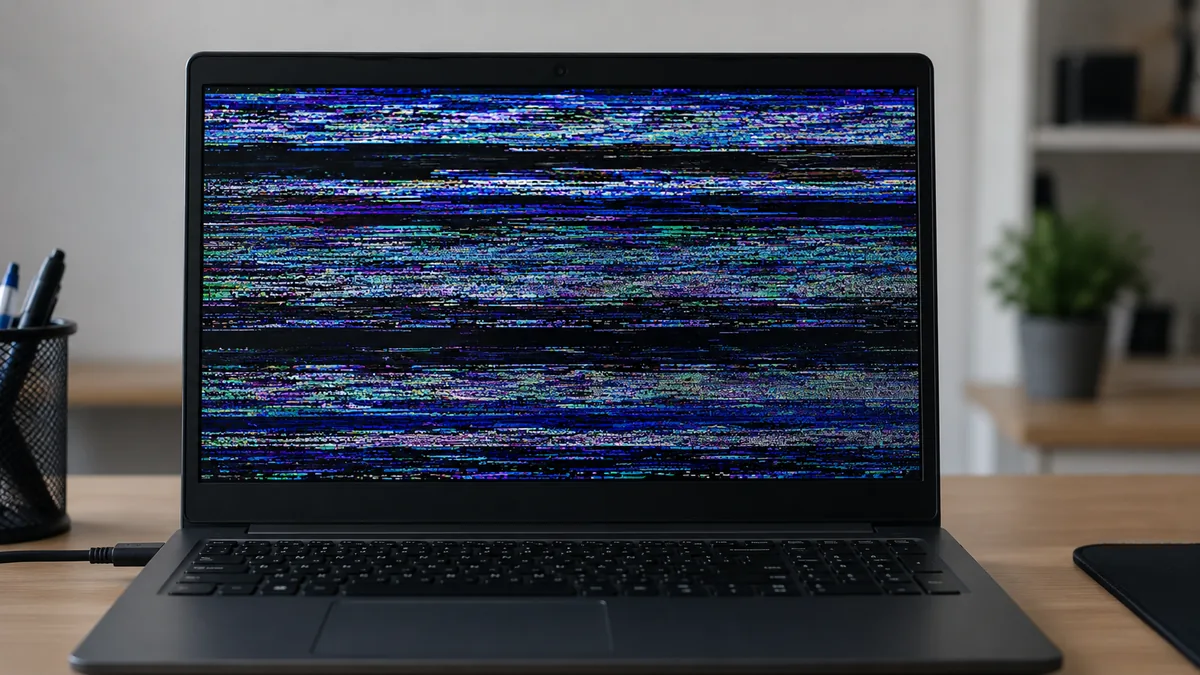
On the software side, the most common cause is an outdated or faulty graphics driver. Drivers translate what your programs want onto the screen, and when one is buggy or mismatched — often after a Windows update — the picture can flash or flicker across the whole display. A close second is a refresh-rate or resolution mismatch: if the display is set to a rate the panel does not properly support, you get a steady flicker or a faint shimmer. The third software cause is an incompatible app — a single program that fights with your display settings and makes the screen flicker only while it or its overlays are active.
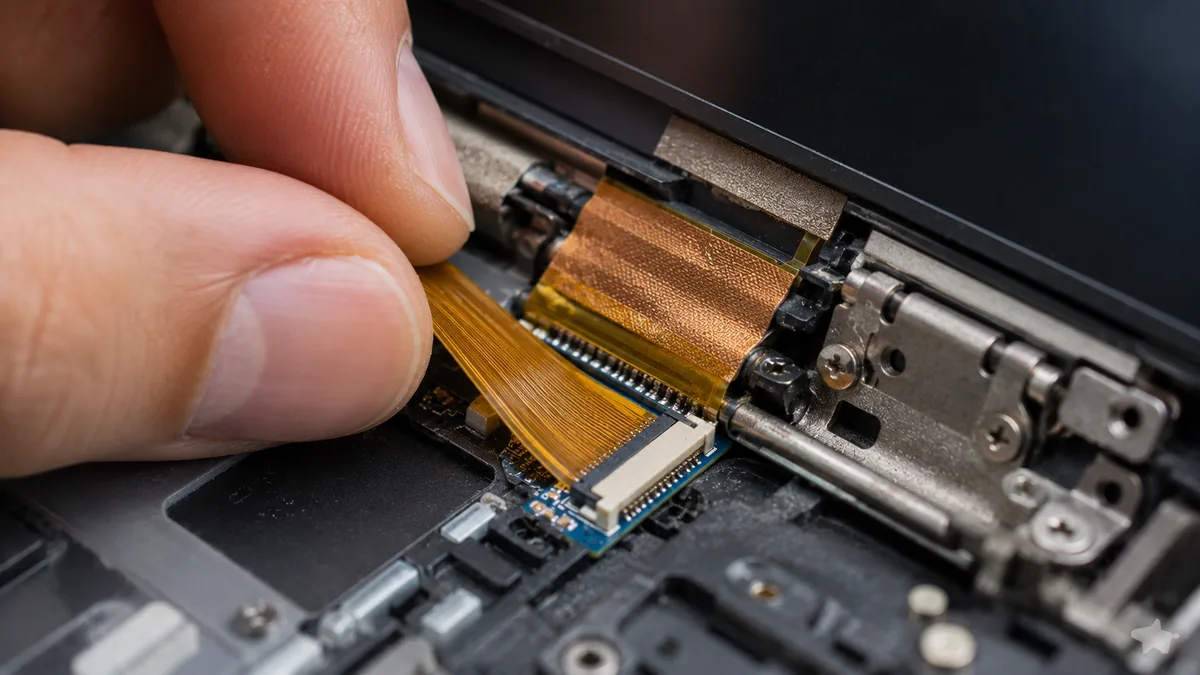
On the hardware side, the usual suspect is the display cable: a thin eDP ribbon that runs from the motherboard, through the hinge, and up to the panel. Because it flexes every time you open and close the lid, it is often worn or chafed exactly where it passes through the hinge, and a damaged section produces flicker that changes as the lid moves. Then there is a failing backlight, which shows as the whole picture pulsing or dimming, and a failing LCD or OLED panel, where the flicker is built into the display itself. A knock or a drop can also leave a loose connector at either end of the cable. Telling these apart by eye is hard — which is exactly why the two tests below matter so much.
The two tests are worth learning by heart. The Task Manager test: open Task Manager and watch it while the screen misbehaves. If Task Manager also flickers, the fault is usually a display driver; if Task Manager stays perfectly steady while everything around it flickers, the fault is usually an incompatible app. The external-monitor test: plug in a second screen. If the external monitor is steady while the laptop's own screen flickers, the fault is inside the lid — the panel or its cable — not the graphics chip. If the external monitor flickers too, the problem is shared, which points at the driver or, less often, the GPU on the board. Between them, these two checks route almost every flicker case to the right fix.
Match your symptom to the cause
Use this quick reference to see where your particular symptom is likely to sit, and whether it is something you can safely check yourself or something for a workshop.
Quick diagnosis
Symptom-to-cause reference
A guide, not a guarantee — the only way to be certain is to test the panel, cable and board on the bench, which is exactly what our free diagnosis does.
Not sure which one it is? Send us a photo.
Tell us the make, model and exactly when the flicker appears — all the time, only in one app, or when you move the lid. A technician replies with a probable cause and an honest price band before you travel — diagnosis is free on walk-ins.
Safe fixes you can try yourself
Work through these in order. They are all safe, none of them involves opening the laptop, and between them they resolve a large share of flickering screens — or at least tell you clearly that the fault is hardware. Stop at the first one that fixes it.
- Run the Task Manager test. Press Ctrl+Shift+Esc to open Task Manager and watch it while the screen flickers. If Task Manager flickers along with the rest of the screen, the cause is almost certainly the display driver, so go to the next step. If Task Manager stays steady while everything else flickers, an incompatible app is to blame — skip to the app step. This one check tells you which fix to try, so do it first.
- Update or roll back the graphics driver. Open Device Manager, expand Display adapters, and update the driver. If the flicker started right after a driver or Windows update, do the opposite instead — roll the driver back to the previous version. A clean, matched graphics driver clears a large share of whole-screen flicker. Restart and check before moving on.
- Set the correct refresh rate and resolution. Go to Settings, then System, then Display, then Advanced display. Make sure the refresh rate is set to the value your panel is rated for, and that the resolution matches the panel's native setting. A mismatched refresh rate is a common, quick cause of a steady flicker or shimmer, and correcting it needs no hardware at all.
- Test an external monitor. Connect a second screen or a TV with the right cable and compare. A steady external screen while the laptop's own screen flickers means the fault is inside the lid — the panel or the display cable — and the graphics chip is fine. If the external monitor flickers too, the fault is the driver or the GPU. This test cleanly splits a panel-side job from a board-side one.
- Note whether the flicker follows the lid angle. With the machine on, very gently change the lid angle a little and watch the screen. If the flicker starts, stops or changes as the lid moves, that points strongly at the display cable worn in the hinge. Just note what you saw — do not keep flexing or forcing the lid to reproduce it, as that can worsen a cable that is already on its way out.
- Uninstall a recently installed app. If the Task Manager test showed a steady Task Manager while the rest flickered, an app is the likely culprit. Think back to anything installed just before the flicker began, and uninstall or update it. Restart and check. If the flicker only appears inside one program, updating that program often settles it.
- Restart cleanly and re-check. After making a change, do a full restart rather than just closing the lid, and give the machine a minute. Some driver and refresh-rate changes only take proper effect after a clean reboot, and a restart also clears a stuck display state that can look like a hardware fault.
Do not open the laptop to prod at the display cable unless you know what you are doing, and do not keep opening and closing the lid to force the flicker to come back — that is exactly the movement that wears the cable through the hinge. Avoid "fix flicker" utilities from unknown sites, which often bundle unwanted software. And if the screen has visible cracks, dark blotches or spreading lines along with the flicker, stop testing and have the panel checked before it fails completely.
When to get professional repair
If the Task Manager test, a matched driver and the correct refresh rate have not stopped the flicker, or if the external-monitor test showed the fault is inside the lid, the cause is hardware and it needs a workshop. At that point it is usually one of three things, and each has a clear fix:
- The display cable. Flicker tied to the lid angle, or a steady external monitor while the laptop's own screen flickers, usually means the eDP ribbon is worn where it bends through the hinge. This is one of the cheaper display parts and a common repair — and because a chafed cable and a tired hinge often go together, our laptop hinge repair service checks both at once.
- The panel. Flicker with lines, blotches or a pulsing backlight, or flicker that persists on a steady external monitor, usually points at the LCD or OLED panel itself. Our laptop screen replacement service fits the correct LCD, OLED or touch panel for your exact model, most often within a day.
- The graphics chip or board. If an external monitor also flickers and no driver fix helps, the fault can be the GPU or its supply on the motherboard. Rather than replacing the whole board, our laptop motherboard repair service traces and fixes the actual failed component at a fraction of the cost of a new board.
The honest bit: we do not know which of these it is until we test it, and neither does anyone quoting you a price sight unseen. Our diagnosis comes first and is free on walk-ins — we tell you whether it is the cable, the backlight, the panel or the board, and what the repair will cost, before any work begins. If we cannot fix it you do not pay a repair fee, and we never invent a fault to justify a bill. For the fine detail of how we test and replace display parts, see our laptop repair procedure. And if your screen shows lines rather than flicker, or the machine will not power on at all, our guides on laptop screen lines and a laptop that won't turn on may fit your symptom better.
Related repair services
If it turns out to be hardware
Screen replacement
Failing panels and backlights swapped for the correct part for your model.
See the service →Hinge repair
Worn hinges and the display cables that chafe and flicker inside them.
See the service →Motherboard repair
GPU faults and display rails traced and fixed on the board.
See the service →Questions we get every week

Laptop screen flickering — frequently asked questions
Why is my laptop screen flickering all of a sudden?
A screen that starts flickering out of nowhere is most often a software cause: an outdated or faulty graphics driver, a Windows update that changed the refresh rate, or a newly installed app that does not get along with your display. Those are all things you can fix yourself. If none of them helps, the fault is usually hardware — a loose or chafed display cable, a failing backlight, or an ageing LCD or OLED panel. The quickest way to tell software from hardware is the Task Manager test and the external-monitor test described on this page.
How does the Task Manager test tell me what's wrong with a flickering screen?
Open Task Manager and watch it while the screen flickers. If Task Manager flickers along with everything else on screen, the problem is almost always a display driver — update or roll it back. If Task Manager stays steady while the rest of the screen flickers, the problem is usually an incompatible app that you should uninstall or update. It is a simple, free check that points you at the right fix before you change any hardware, and it takes about a minute to do.
My laptop screen flickers when I move the lid. What does that mean?
Flicker that changes as you open, close or gently flex the lid points strongly at the display cable — the thin eDP ribbon that runs from the motherboard, through the hinge, to the panel. That cable is often worn where it bends through the hinge, and moving the lid disturbs the damaged section. This is a hardware fault that needs a workshop. Do not keep flexing the lid to reproduce it, as that can worsen the damage; note what you saw and have the cable and hinge checked.
If I plug in an external monitor and it looks fine, is my laptop's graphics chip okay?
Most likely, yes. Connect an external monitor and compare: if the external screen is rock steady while the laptop's own screen flickers, the graphics chip and driver are fine and the fault is inside the lid — the panel, the backlight or the display cable. If the external monitor also flickers, the problem is shared, which points at the graphics driver or, less often, the GPU on the motherboard. This one test splits most flicker cases cleanly into a panel-side job or a board-side job.
Can a wrong refresh rate really make my laptop screen flicker?
Yes, and it is a common and easy fix. If Windows or an app has set the display to a refresh rate or resolution the panel does not properly support, you can get a steady flicker or a subtle shimmer. Go into display settings, open the advanced display options, and make sure the refresh rate is set to the value your panel is rated for. While you are there, check that the resolution matches the panel's native setting. If correcting these stops the flicker, no hardware repair is needed at all.
Is a flickering laptop screen worth repairing, or should I replace the laptop?
Usually worth checking first, because a large share of flickering screens are either a free software fix or a modest hardware job. A display cable is one of the cheaper parts in a laptop; even a panel replacement is normally a fraction of the price of a new machine. We diagnose the exact cause before quoting — driver, cable, backlight or panel — so you get an honest repair figure and a read on the machine's remaining value, and you decide with both numbers in front of you. Diagnosis is free on walk-ins.
Bring it in for a free diagnosis
Walk-ins welcome from the CBD, Orchard, Novena, Toa Payoh, Bishan, Ang Mo Kio, Jurong East, Clementi, Tampines, Bedok, Woodlands, Yishun, Hougang and Punggol. We tell you what is wrong and what it costs before any work begins.