
Troubleshooting guide · Singapore
Laptop charging slowly? Find out why before you replace anything
A laptop that crawls from empty to full over half a day is frustrating, but it is far more often the wrong charger, the wrong port or a heavy workload than a dying machine. This guide walks you through the safe checks you can do at home, what each symptom points to, and the point at which a slow charge is worth handing to a workshop.
Use the original charger, or a replacement of the same wattage, plugged into the correct charging port. Try charging with the laptop switched off to separate the charger from the workload, and let a hot machine cool down. If a known-good, correct-wattage charger in the right port still charges slowly with the lid closed, the fault is usually a worn charging port, an aged battery or the board's charging circuit — none of which is a safe home fix, and all of which we can diagnose for free before you commit to anything.
On this page
Why a laptop charges slowly
"Charging slowly" is really a question about power in versus power out. A laptop battery fills at whatever rate the charger can safely push into it, minus whatever the laptop is spending on the screen, the processor and everything else at that moment. When charging feels slow, one of those two numbers is usually to blame: either not enough power is coming in, or too much is going straight back out. Nail down which side of that equation you are on and you have solved most of the puzzle before you even open a settings menu.
On the power-in side, the biggest single cause we see is an underpowered or non-original charger. This has become far more common in the USB-C era, because so many chargers now share the same connector. A phone charger, a slim travel brick or a low-wattage power bank will physically plug into a USB-C laptop and appear to be "charging", but it can only deliver a fraction of the wattage the machine actually wants. A laptop designed for a 90W charger being fed 30W will crawl, and under any real load it may not gain charge at all. The same happens with a cheap replacement barrel-plug adapter rated below the original.
Still on the power-in side, USB-C laptops have a second trap: the wrong port. Not every USB-C socket on a laptop carries full charging power. Some are wired for data only, some deliver a reduced wattage, and only the port the manufacturer marks for charging will pull the battery up at full speed. Plug into the wrong one and a perfectly healthy charger looks slow. Beyond the port choice, a worn cable or charging port with poor contact throttles the delivered power — a frayed cable, a bent USB-C tip, or a loose DC-in jack that only makes a good connection at a certain angle all reduce the current that reaches the board.
On the power-out side, the usual culprit is simply heavy load while charging. Gaming, video rendering, virtual machines and long video calls can draw almost as much power as the charger supplies, so very little is left over to fill the battery. This is normal physics, not a fault, but it convinces a lot of people their charging is broken when it is really just busy. Related to this is heat: a hot battery charges more slowly on purpose, because the charging circuit deliberately slows down to protect the cells, and in Singapore's climate a laptop running warm in a bag or on a bed traps heat and throttles itself.
Finally, when the charger, port, cable, load and temperature all check out, the cause has usually moved inside the machine. A degraded, aged battery charges slowly, stalls at a certain percentage, or drains almost as fast as it fills, because its usable capacity has shrunk with age and charge cycles. And least often, there is a genuine charging-circuit fault on the motherboard — a weak charging IC or a partly failed power path that limits current into the pack. That last one sounds alarming, but it is the rarest of the group and, like the rest, is something a workshop can confirm on a bench supply rather than guess at.

Match your symptom to the cause
Use this quick reference to see where your particular symptom is likely to sit, and whether it is something you can safely check yourself or something better left to a workshop.
Quick diagnosis
Symptom-to-cause reference
A guide, not a guarantee — the only way to be certain is to measure the current going into the board and the pack, which is exactly what our free diagnosis does.
Not sure which one it is? Send us a photo.
Tell us the make, model, the wattage printed on your charger and what percentage it climbs in an hour. A technician replies with a probable cause and an honest price band before you travel — diagnosis is free on walk-ins.
Safe fixes you can try yourself
Work through these in order. They are all safe, none of them involves opening the laptop, and between them they explain and cure the large majority of slow-charging machines. Stop at the first one that restores a normal charging speed.
- Use the original or a correct-wattage charger. Find the wattage printed on your original charger — something like 65W, 90W or 100W — and make sure whatever you are actually plugging in matches it. A phone charger, a slim travel brick or a low-wattage power bank will trickle-charge at best. If you have lost the original, a replacement of the same wattage with the correct connector will restore full speed; a lower-rated one will not. This one change fixes more slow-charging complaints than any other.
- Plug into the correct charging port. On a USB-C laptop, look for a small battery or lightning-bolt icon beside one of the ports, or check the manual to find the primary charging port. Data-only or secondary ports charge slowly or not at all. Move the cable to the marked port and the speed often jumps straight back up. On barrel-plug laptops there is only one socket, so you can skip this step.
- Charge with the laptop switched off. This is the single most useful test. Shut the machine down fully, plug in, and watch how quickly the percentage climbs. If it charges fast when off but slowly when on, the charger and port are fine and the "slow charge" was really your workload. If it is still slow with the lid closed and the power off, the fault is more likely the charger, the port, the battery or the board.
- Close heavy apps while charging. If you must use the laptop on charge, quit games, video editors, virtual machines and anything pinning the processor or graphics chip. Everything the machine is doing is paid for out of the charger's power budget first, and only the leftover fills the battery. Lightening the load frees up power to charge faster.
- Let a hot laptop cool down. A warm battery charges slowly by design, because the charging circuit throttles to protect the cells. Move the laptop off soft surfaces like a bed or sofa, make sure the vents are clear, and give it a few minutes to cool in an air-conditioned room. Charging speed usually recovers as the temperature drops.
- Check the Windows battery report. On Windows you can generate a battery health report that shows the design capacity against the current full-charge capacity. A large gap between the two means the pack is worn, which explains slow charging and short runtime. This is a safe, read-only check that tells you whether the battery is the likely culprit before you spend anything.
- Inspect the cable and port for damage or debris. Look along the cable for kinks, fraying or a spongy section near the plug, and check the USB-C tip or barrel plug for bending. Shine a light into the charging port and gently blow out any lint or dust — pocket fluff packed into a port is a real and common cause of poor contact. Do not dig into the port with metal; a puff of air is enough.
Do not force a mismatched or damaged charger just because it fits, do not poke into the charging port with a pin, needle or anything metal, and do not keep using a machine whose base or trackpad feels raised — that is a swollen battery, which is a fire risk and needs proper handling. If a charger ever runs very hot, smells, or the cable is visibly damaged, stop using it and replace it rather than risk it.
When to get professional repair
If you have confirmed the original or correct-wattage charger, the right charging port, a clean cable and a light workload, charged with the laptop switched off and cool, and it still crawls, the fault has moved beyond anything you can safely fix at home. At that point the cause is usually one of three things, and each needs a workshop:
- The charging port. A worn DC-in jack or a damaged USB-C connector makes poor contact and throttles the current reaching the board, so even a strong charger delivers a weak charge. This is a common and very repairable fault — see our laptop charging port repair service.
- The battery. An aged pack that has lost capacity charges slowly, stalls part-way, or drains almost as fast as it fills, and a swollen pack is a safety issue on top of that. Our battery replacement service handles these the same day on most models and usually restores normal charging speed outright.
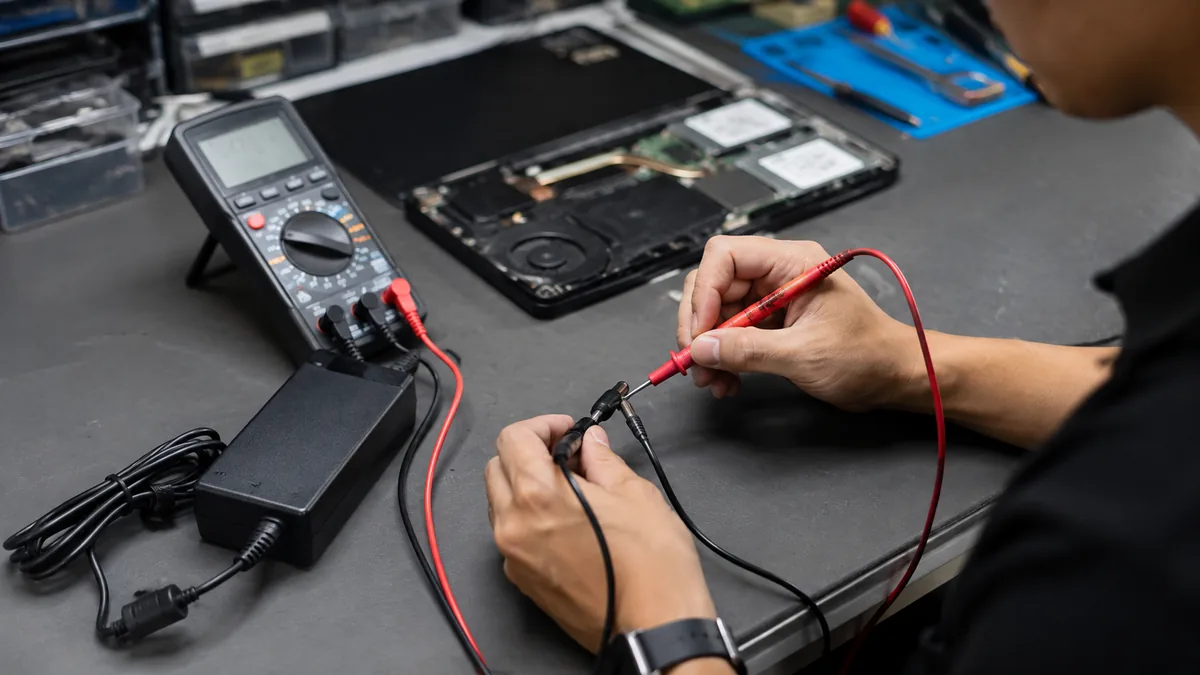
- The motherboard. A weak charging IC or a partly failed power path limits the current into the battery. Rather than replacing the whole board, our laptop motherboard repair service measures the charge current on a bench supply, traces the actual failed component and fixes it — usually at a fraction of the cost of a new board.
Telling those three apart by eye is nearly impossible, which is why we measure rather than guess. On the bench we watch the current the charger delivers, the current reaching the board and the current actually going into the pack, and the numbers point straight at the weak link. If you are working through a wider set of charging problems, our companion guides on a laptop battery that will not charge at all and a laptop running hot while charging cover the neighbouring symptoms, and the laptop repair overview explains how we approach every brand.
Whatever the cause, our diagnosis comes first and is free on walk-ins: we tell you what is wrong and what it will cost before any work begins, and if we cannot fix it you do not pay a repair fee. There are no invented prices and no pressure — most slow-charging laptops turn out to be a cheap charger or a straightforward battery rather than anything dramatic, and it is almost always worth finding out which before you write the machine off.
Related repair services
If it turns out to be hardware
Charging port repair
Worn jacks and connectors that throttle the power reaching the board.
See the service →Battery replacement
Worn packs that charge slowly or drain fast, replaced same day.
See the service →Motherboard repair
Weak charging ICs and failing power paths traced and fixed.
See the service →Questions we get every week

Laptop charging slowly — frequently asked questions
Why is my laptop charging so slowly all of a sudden?
The most common reason is that the laptop is no longer getting the wattage it expects. Check the charger first: a phone charger, a low-wattage USB-C power bank, or a replacement brick rated below the original can only trickle-charge a laptop that wants 65W, 100W or more. A worn cable or a loose charging port also cuts the delivered power. After that, look at what the laptop is doing — gaming, video calls or rendering while plugged in can draw almost as much as the charger supplies, leaving little left to fill the battery. Rule out those three before assuming the battery or the board is at fault.
Does the wattage of my charger really affect how fast a laptop charges?
Yes, more than anything else. A laptop charges as fast as the charger can safely deliver, so a 30W USB-C brick will fill a machine designed for a 90W charger at roughly a third of the speed — if it keeps up at all under load. USB-C Power Delivery negotiates a wattage between the charger and the laptop, and it always settles on the lower of the two. Using the original charger, or a replacement of the same wattage and the correct connector, is the single biggest thing you can do for charging speed. If you must use a spare, check the numbers printed on the brick against your original.
Why does my USB-C laptop charge slowly on one port but not another?
On many laptops the USB-C ports are not identical. Some carry full charging power, some carry only data or a reduced wattage, and only the ports marked for charging will pull the battery up quickly. Look for a small battery or lightning-bolt icon next to the port, or check the manual to see which one is the primary charging port. Plugging into a data-only or secondary port is one of the most common reasons a perfectly good charger seems to charge slowly. Move the cable to the correct port and the speed usually jumps straight back up.
Should I use the laptop while it is charging if it is charging slowly?
You can, but heavy use will slow charging and it is worth understanding why. The charger has a fixed budget of power. Everything the laptop is doing — the screen, the processor, the graphics chip — is paid for out of that budget first, and only what is left over goes into the battery. Gaming or video editing can consume almost the whole budget, so the battery barely fills or even drops while plugged in. If you want the fastest charge, close heavy apps or, better still, charge with the laptop switched off. That single test also tells you whether the slow charge is really the charger or just the workload.
Can a worn-out battery make a laptop charge slowly?
It can. Laptop batteries lose capacity as they age, and an old pack can charge slowly, refuse to go past a certain percentage, or report a full charge that drains within minutes. On Windows you can generate a battery report to see the design capacity against the current full-charge capacity — a large gap means the pack is worn. A tired battery is not dangerous on its own, but a swollen one is, and both are worth replacing. If the charger and port check out and the battery report shows heavy wear, a fresh battery usually restores normal charging speed.
The charger is correct but my laptop still charges slowly — is it a repair job?
Very likely, yes. If you have confirmed the original or correct-wattage charger, the right charging port, a clean cable and a light workload, and it still crawls, the fault has usually moved inside the machine. The three common culprits are a worn charging port with poor contact, an aged battery that no longer accepts a fast charge, and a fault on the charging circuit of the motherboard. All three need a workshop to diagnose properly, because the only sure way to tell them apart is to measure the current going into the board and the pack. Our diagnosis is free on walk-ins, so you find out which one it is before committing to anything.
Bring it in for a free diagnosis
Walk-ins welcome from the CBD, Orchard, Novena, Toa Payoh, Bishan, Ang Mo Kio, Jurong East, Clementi, Tampines, Bedok, Woodlands, Yishun, Hougang and Punggol. We tell you what is wrong and what it costs before any work begins.