

Buying & education guide · Singapore
How to choose a laptop repair shop
Handing your laptop to a stranger is an act of trust — with your money, your machine and, most of all, your data. Singapore has no shortage of repair shops, and they are not all the same. This guide sets out exactly what separates a workshop worth trusting from one to walk past: the reviews, the written quote, the warranty, the skill and the honesty. Use it as a checklist before you hand anything over.
Choose a laptop repair shop with genuine, detailed reviews and a real track record, not a scattering of one-line ratings. Insist on a diagnosis first and a written quote before any money changes hands — never a firm price guessed over the phone. Check that they offer a clear written warranty on both parts and labour, that they can actually repair the board rather than only swap whole assemblies, and that they will show you the fault and explain it plainly. Ask how they handle your data, and make sure any diagnostic-fee policy is spelled out honestly up front. A trustworthy shop welcomes these questions — and never pressures you to decide on the spot.
On this page
Reviews and a real track record
Start where everyone else does — the reviews — but read them the way a sceptic would. A trustworthy shop has a long history of detailed feedback: people describing the specific fault, how it was handled, whether the price matched the quote, and how the machine ran afterwards. That texture is hard to fake. A wall of identical five-star, one-line ratings posted in a short window is not the same thing, and neither is a perfect score with no substance behind it. Look for how the shop responds to the occasional unhappy customer, too — a measured, specific reply tells you more about how they will treat you than any amount of praise.
A real track record shows up in other ways as well: years in business at a findable address, technicians who are named and accountable, and a body of written material — guides, service pages, honest explanations — that shows the shop actually understands the work. A workshop that has taken the time to explain how it handles motherboard repair or the difference between original and aftermarket parts is one that expects to be judged on its knowledge, not just its price. Reputation built patiently over years is the single best predictor of how your own repair will go.
Diagnosis first, then a written quote
The most important habit to look for is the order in which a shop does things. The right sequence is always diagnose, then quote, then repair — never quote first. A firm price offered over the phone, before anyone has opened the machine, is a guess dressed up as a number, and guesses have a way of drifting upward once your laptop is already on the bench and you are emotionally committed. A no-power laptop, for instance, might need a small charging-port repair or serious board-level work, and those are wildly different bills. Only a proper diagnosis tells them — and you — which one it is.
Once the fault is known, a good shop puts the quote in writing. That written quote should name the fault, the parts, the labour and the warranty, and it should be the figure you actually pay barring something genuinely unforeseen — in which case they stop and check with you first, rather than pressing on and presenting a bigger bill at collection. A written quote is not bureaucracy; it is your protection against surprise add-ons and your clean, pressure-free point to say no. This is the standard we hold ourselves to: diagnosis is free on walk-ins, the quote is written down before we touch anything, and there is no obligation to proceed. If you want a sense of the numbers before you visit, our guide to laptop repair costs in Singapore lays out realistic bands.
Board-level skill, not just parts-swapping
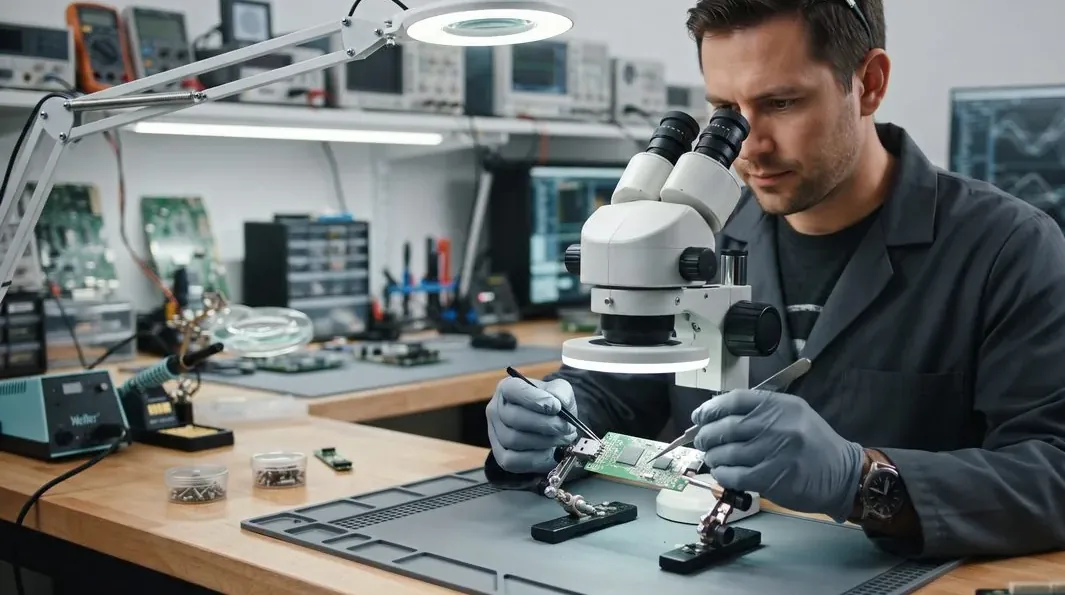
Here is a distinction most owners never think to ask about, and it can be the difference between a fifty-dollar fix and a five-hundred-dollar one. Many shops only swap parts: they replace whole assemblies — a screen, a battery, or an entire motherboard — without ever diagnosing the specific component that failed on the board. So when a single charging chip or a shorted capacitor gives out, a swap-only shop quotes you a whole new motherboard, because replacing the board is the only tool they have.
A shop that does genuine component-level — or board-level — repair works differently. Using microsoldering, it finds the individual failed part and replaces just that, often saving the board and a large chunk of your money. Not every fault needs this, and not every fault can be fixed this way, but a workshop that can do it will always give you the cheaper honest option when it exists. Ask directly: do you repair the board, or only replace it? The answer tells you whether you are dealing with a technician or a swapper. This is core to how we work — see our laptop motherboard repair page — and it is why so many machines other shops declared dead leave our bench working.
Warranty, parts quality and transparency
A warranty is a shop telling you, in writing, that it stands behind its own work. Look for one that covers both the part and the labour, states clearly how long it lasts, and explains plainly what is and is not included. Be cautious of a shop that offers no warranty at all, or one that warranties the part but not the workmanship — because assembly and board-level work is precisely where skill shows, and where a cheap job comes back to bite. Get the terms in writing and keep them. Our full guide to laptop repair warranties walks through what good cover actually looks like.
Parts quality is the other half of the equation. A straight shop is honest about whether it is fitting an original part or a quality aftermarket one, and about the trade-offs of each — there are legitimate reasons to choose either, but you deserve to know which you are paying for. A shop that quietly fits the cheapest panel or cell it can find, or that dodges the question, is one to be wary of. Our original versus aftermarket parts guide explains the differences so you can ask the right questions.
Above all, look for transparency. The best signal of a trustworthy workshop is one that will show you the fault — the swollen battery, the corroded board, the failed connector — and talk you through it in plain language rather than hiding behind jargon or a closed door. A shop confident in its diagnosis has nothing to conceal. If a workshop is happy to open the machine in front of you and explain what it sees, that openness almost always runs through everything else it does.
Data handling, fees and turnaround
Your laptop holds more of your life than its resale value ever reflects, so how a shop treats your data matters enormously. A responsible workshop treats your files as private, accesses them only when the repair genuinely requires it, and warns you in advance if a fix carries any risk to your storage. Most common repairs — a screen, a battery, a keyboard — never touch your data at all. Where a fault does put files at risk, an honest shop tells you before starting and, if the drive itself has failed, points you towards proper data recovery rather than gambling. Ask how they handle data, and back up before any repair whenever you can — it is the one precaution that is always worth taking.
On diagnostic fees, do not assume a charge is a bad sign. A real diagnosis takes time and skill, and some shops charge for it honestly. What matters is that the policy is clear before you commit: how much it is, whether it is credited against the repair if you go ahead, and what you get for the money. A fair, transparent fee is fine; a vague charge you only discover at collection is not. We keep it simple with free diagnosis on walk-ins, so you can get an honest assessment and a written quote before deciding anything.
Finally, weigh turnaround with realism. A shop that promises everything in an hour, every time, is either not diagnosing properly or not ordering the right parts. Common repairs are often quick, but board-level work and parts that must be sourced take longer — and a straight answer about timing is worth more than an optimistic one you will be disappointed by. A shop that under-promises and keeps you informed is behaving the way it will behave with everything else.
Questions to ask before you hand it over
You do not need to be technical to sort a good shop from a risky one. A handful of direct questions, and the way they are answered, will tell you almost everything. Ask these before you leave your laptop:
- Can you diagnose the fault before quoting a price? The answer should be a confident yes. A shop that quotes firmly without opening the machine is guessing.
- Will the quote be in writing, and is it fixed? You want the fault, parts, labour and warranty written down, and a promise that they will check with you before exceeding it.
- What warranty do I get, and on what? Listen for cover on both parts and labour, a clear duration, and honest limits — in writing.
- Do you repair the motherboard, or only replace it? A shop that can do component-level work can often save the board — and your money — where a swapper cannot.
- What happens to my data during the repair? A good shop treats it as private, touches it only when necessary, and warns you of any risk before starting.
- Do you charge a diagnostic fee, and is it credited if I proceed? Either answer can be fine — what matters is that it is explained clearly and up front, not sprung on you at collection.
Notice that none of these are trick questions. A shop that answers them plainly, without irritation or evasion, is showing you exactly how it will handle the repair itself. One that bristles at being asked is telling you something too.
Some behaviours should end the conversation regardless of price or convenience:
- A firm price over the phone, sight unseen. Nobody can quote a real figure without diagnosing the fault first. A confident phone price is a guess that usually grows.
- No warranty at all. A shop unwilling to stand behind its own work in writing is telling you how much it trusts that work.
- A "reflow" sold as a permanent GPU fix. Reheating a chip can revive a machine briefly, but it is a temporary measure, not a lasting repair — anyone presenting it as permanent is not being straight with you.
- Pressure to decide immediately. Urgency and "today only" framing are sales tactics, not diagnostics. A good shop is happy for you to take your quote away and think.
- Refusal to show you the fault. If a workshop will not open the machine or explain what is wrong in plain terms, ask why. Confidence has nothing to hide.
- A blanket "no fix, no fee" with nothing in writing. The phrase sounds reassuring, but without written terms defining what counts as a fix and what happens to your machine and data if they cannot complete it, it is just a slogan.

The standard to expect
Pulling it together, the shop worth trusting is the one that diagnoses before it quotes, puts the price in writing, backs its work with a warranty on parts and labour, can repair the board rather than only swap it, handles your data with care, and is transparent enough to show you the fault and explain it. None of this is exotic — it is simply what honest, competent repair looks like, and it is the standard we hold ourselves to every day. We are an independent workshop, not affiliated with any manufacturer, and we would rather earn a reputation slowly by being straight with people than win one repair by overselling it. If you are weighing up where to take your machine, read a little more about how we work, and when you are ready, come in for a free diagnosis and written quote with no obligation to proceed. If you are still deciding whether the machine is even worth fixing, our guide on whether to repair or replace a laptop is a sensible next read.
Bring us the fault — leave with a written quote.
Diagnosis is free on walk-ins, the quote is written down before we touch anything, and there is never any pressure to proceed. That is the standard every laptop repair shop should meet — come and see it.
Keep reading
Guides that help you choose well
Laptop repair warranties explained
What good cover looks like, and how to read the fine print before you commit.
Read the guide →How much does laptop repair cost?
Realistic Singapore price bands so you can judge a quote fairly.
Read the guide →Original vs aftermarket parts
The trade-offs behind the parts a shop fits — and the questions to ask.
Read the guide →Questions we get every week
Choosing a repair shop — frequently asked questions
How do I know if a laptop repair shop is trustworthy?
Look for the signals that are hard to fake: a long track record of genuine, detailed reviews rather than a handful of five-star lines; a willingness to diagnose your machine and give you a written quote before any money changes hands; a clear warranty on both parts and labour; and staff who can explain what is actually wrong in plain language and show you the fault. A trustworthy shop is comfortable being questioned, never pressures you to decide on the spot, and is honest about the cases where a repair is not worth it. If a workshop ticks those boxes it will almost always treat your laptop well, because those habits are the same ones that build a reputation over years.
Should a laptop repair shop give me a written quote before starting?
Yes. A firm figure over the phone before anyone has opened the machine is a guess, and guesses drift upward once your laptop is already on the bench. The right sequence is diagnosis first, then a written quote that lists the fault, the parts, the labour and the warranty, and only then the repair. A written quote protects you from surprise add-ons and gives you a clear point to say no. At our workshop diagnosis is free on walk-ins and the quote is put in writing before we touch anything, so you decide with real numbers and no obligation.
What warranty should a good laptop repair come with?
A good repair comes with a written warranty that covers both the replacement part and the labour, states how long it lasts, and explains plainly what is and is not included. Be wary of a shop that offers no warranty at all, or one that covers the part but not the workmanship, because board-level and assembly work is exactly where skill shows. Ask for the terms in writing and keep them. Our own jobs carry a written warranty on parts and labour, and we would rather explain the limits honestly up front than leave you guessing after the fact.
What is the difference between component-level repair and parts-swapping?
Parts-swapping means replacing whole assemblies — a screen, a battery, or an entire motherboard — without diagnosing the specific fault on the board. Component-level, or board-level, repair means finding the individual failed chip, capacitor or connector and replacing just that, using microsoldering. It matters because a swap-only shop will quote you a whole new board for a fault that a board-level workshop can fix for a fraction of the cost. Many faults do not need a new motherboard at all. Choosing a shop that can actually repair the board, not only replace it, often saves both money and a perfectly good machine.
Is a diagnostic fee a bad sign at a laptop repair shop?
No, a diagnostic fee is not automatically a bad sign — a proper diagnosis takes real time and skill, and a shop that charges for it may simply be honest about that. What matters is that the policy is explained clearly before you commit: how much it is, whether it is credited towards the repair if you proceed, and what you get for it. A fair, transparent fee is fine; a vague charge you only hear about at collection is not. We keep it simple by offering free diagnosis on walk-ins, so you can get an honest assessment and a written quote before deciding anything.
What happens to my data when I send my laptop for repair?
A responsible shop treats your data as private, accesses it only when the repair genuinely requires it, and tells you in advance if a fix carries any risk to your files. Ask directly how they handle data, whether they can work without wiping your drive, and what happens if the storage itself has failed. Most repairs, such as a screen, battery or keyboard, never touch your files at all. Where a fault does put data at risk we will say so before starting and, if needed, point you to proper data recovery rather than gambling with your files. Back up before any repair when you can — it is the one precaution that is always worth taking.
Now you know what to look for. Come and see it in practice.
A free, no-obligation diagnosis and a written quote before anything is touched — the same standard this guide asks of every shop. Walk in, or send a photo and we will tell you what we find.